
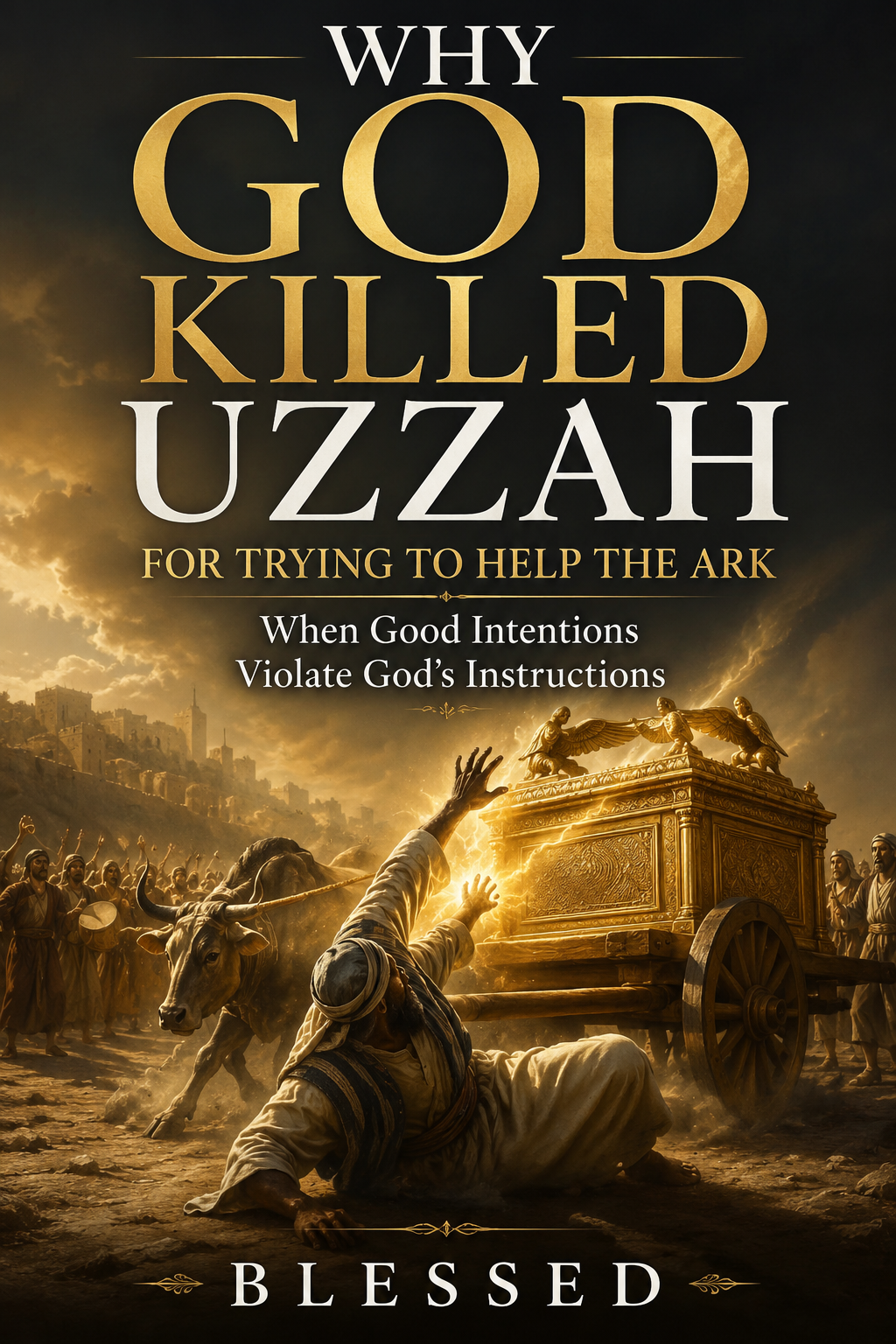
When Good Intentions Violate God’s Instructions
Introduction: The Day One Touch Changed Everything
Some passages in the Bible comfort us. Others inspire us.
But a few leave us deeply unsettled.
The story of Uzzah is one of them.
Picture the scene. Thousands of joyful worshippers. King David dancing before the Lord. Musicians playing. People are shouting in celebration.
For the first time in years, the Ark of the Covenant is returning to Jerusalem. It is the visible symbol of God’s presence among His people.
So this should have been a day of unforgettable joy.
Instead, it became a day of sudden tragedy.
The oxen pulling the cart stumbled. The Ark shifted. Instinctively, a man named Uzzah reached out to steady it.
He wasn’t trying to steal it. He wasn’t mocking God. He wasn’t rebelling.
He was trying to help.
But before anyone understood what had happened, Uzzah fell to the ground. He was dead.
The celebration stopped. The music ended. The crowd fell silent. Even King David was shocked.
For generations, readers have wrestled with the same question: Why would a loving God kill a man for trying to keep the Ark from falling?
At first glance, God’s judgment seems harsh. Almost unfair. After all, wasn’t Uzzah acting with good intentions?
Wouldn’t most of us have done exactly the same thing?
The answer reveals one of the Bible’s most important lessons. And it reaches far beyond Uzzah.
It speaks to churches. It speaks to Christian leaders. It speaks to every believer who has ever assumed that sincerity is enough.
In God’s kingdom, good intentions are never a substitute for faithful obedience.
Many Christians today sincerely want to serve God. They volunteer. They give generously. They preach. They sing. They lead ministries.
Yet it is possible to be passionately devoted while quietly ignoring God’s instructions.
This account is not meant to scare us. Instead, it is meant to deepen our reverence for God.
The God who loves us is also the God who is holy. And His holiness deserves more than our enthusiasm.
It deserves our obedience.
A Celebration That Ended in Silence
You can read this story in 2 Samuel 6 and 1 Chronicles 13.
For years, the Ark had remained in the house of Abinadab. The Philistines had returned it long before.
Now King David wanted to bring it to Jerusalem. He wanted the city to become Israel’s political capital and the center of worship.
David’s desire was noble. His goal was honorable. He wanted God’s presence at the heart of the nation.
So thousands gathered to celebrate. Musicians played harps, cymbals, tambourines, and trumpets.
Everything looked like a great spiritual success.
But there was one problem. Almost no one noticed it.
The people were moving the Ark the wrong way.
God had commanded the Levites to carry the Ark on their shoulders. Instead, the people placed it on a new cart pulled by oxen.
It seemed practical. It seemed efficient. It even seemed respectful, since the cart was brand new.
But God had already given clear instructions centuries earlier. The Ark was never to ride on a cart. Only the Kohathite Levites could carry it, using poles placed through its rings. No human hand was ever to touch it directly.
God had not left room for personal preference. He had already spoken.
So could this still happen today? Yes. We can get so excited about doing something for God that we forget to ask whether we’re doing it His way.
Success can hide disobedience.
Crowds can applaud what God has never approved. A ministry can look fruitful while quietly drifting from biblical foundations. In other words, popularity is not proof of obedience. Good results don’t always mean God’s approval.
The journey to Jerusalem began with worship. But underneath the celebration sat a dangerous assumption: sincere intentions meant the details no longer mattered.
The people were about to learn otherwise.
The Fatal Touch That Shocked a Nation
The procession moved forward. Then the oxen stumbled. The cart shook. For a brief moment, the Ark looked unstable.
Without thinking, Uzzah stretched out his hand.
“And when they came to Nachon’s threshingfloor, Uzzah put forth his hand to the ark of God, and took hold of it; for the oxen shook it.” — 2 Samuel 6:6 (KJV)
Everything happened in seconds. One instinctive reaction. One outstretched hand. One touch.
Then came one of the most sobering verses in Scripture.
“And the anger of the Lord was kindled against Uzzah; and God smote him there for his error; and there he died by the ark of God.” — 2 Samuel 6:7 (KJV)
The music stopped. The celebration ended. In an instant, the joyful procession became a funeral.
David himself was stunned. The man who wrote songs about trusting God now struggled to understand Him.
“How shall the ark of the Lord come to me?” — 2 Samuel 6:9 (KJV)
It’s an honest question. And you may have asked something similar yourself: “Lord, why would You judge someone who seemed to be trying to do the right thing?”
That question deserves an honest answer. The answer isn’t found in Uzzah’s intentions. It’s found in God’s holiness.
Most people focus on the moment Uzzah touched the Ark, but the real problem started much earlier. The Ark should never have been on that cart in the first place.
So Uzzah’s touch wasn’t the first act of disobedience. It was the last act in a chain of ignored instructions. His hand reached out because the nation had already chosen convenience over obedience.
That’s often how spiritual failure happens. It rarely begins with one dramatic mistake.
Instead, it begins with small compromises. One ignored instruction. One unnecessary shortcut. One decision to trust human wisdom over God’s Word.
Eventually, those compromises produce consequences no one saw coming.
Why God Was Not Being Unfair
After Uzzah’s death, many readers ask the same question. Was God’s judgment too severe?
From a human view, this is hard to understand. Uzzah wasn’t attacking the Ark. He wasn’t trying to dishonor God. He wasn’t mocking God’s commands.
He saw something valuable about to fall, and his natural reaction was to protect it. Honestly, most of us would have done the same thing.
So why did God respond with such seriousness?
God wasn’t judging Uzzah because helping was wrong. He was judging how the nation had treated His holiness.
The Ark was no ordinary object. It represented the presence and glory of God among His people. So the Israelites weren’t free to handle it their own way, even if their ideas seemed reasonable.
The priests and leaders already knew the instructions. This wasn’t a lack of information. It was a case of human reasoning replacing divine command.
Here’s one of the hardest lessons in spiritual life: God’s commands are not suggestions.
When God gives instructions, obedience becomes an expression of trust. Disobedience, even when wrapped in good motives, reveals something deeper. It shows we believe our wisdom outranks God’s.
Think of it this way. Imagine an experienced engineer gives you instructions for operating a complex machine. Some steps might feel unnecessary. You might think, “I understand this machine. I’ll do it my own way.”
But ignoring those instructions can lead to serious consequences.
The same is true in our relationship with God. He understands what we cannot see. His commands don’t exist to restrict us. They exist to protect us and keep us aligned with His purpose.
Uzzah’s story teaches us something important. God’s love and God’s holiness cannot be separated. The same God who shows mercy also deserves reverence.
The Holiness We Have Forgotten
Why does Uzzah’s story still feel so shocking? Because many of us have lost a deep understanding of God’s holiness.
We often talk about God’s love. We celebrate His forgiveness and His grace. And all of that is true.
But the Bible also reveals something else. God is holy. He is completely pure, entirely separate from sin, and worthy of absolute honor.
Throughout Scripture, people responded to God’s holiness with reverence.
“Do not come near. Take your sandals off your feet, for the place where you are standing is holy ground.” — Exodus 3:5
“Woe is me! For I am lost; for I am a man of unclean lips.” — Isaiah 6:5
People never approached God’s holiness casually.
Yet the modern world often trades reverence for familiarity. We can start treating God as though He exists to serve our preferences. We approach worship casually. We adjust biblical teaching to fit our opinions. We pick which commands to follow and which to ignore.
But Uzzah’s story reminds us of something important. God is not made in our image. He isn’t obligated to meet our expectations.
He is the King. He is the Creator. He is worthy of obedience.
This isn’t about fear. It’s about understanding His greatness.
A healthy relationship with God holds both intimacy and reverence together. Yes, we can come boldly before Him because of His mercy. But we must never forget we’re approaching a holy God.
Uzzah lost his life because God’s holiness was ignored. Samson lost his strength because God’s presence quietly departed. Discover the vital lesson every believer needs to learn in our related article: Why Samson Never Realized the Spirit Had Left Him.
When Good Intentions Become Dangerous
Here’s one of the greatest dangers in spiritual life: believing good intentions automatically make something acceptable to God.
Good intentions matter. God cares about the heart. But good intentions alone are not enough.
Consider King Saul. He offered sacrifices because he wanted victory and God’s favor. His intentions may have looked religious. But he still disobeyed God’s command.
“To obey is better than sacrifice, and to heed is better than the fat of rams.” — 1 Samuel 15:22
In short, God is not impressed when we replace obedience with activity.
A person can work hard for God while ignoring what God actually said. A church can stay busy while losing its biblical direction. A ministry can attract crowds while compromising truth.
A believer can have passion without understanding.
So the question isn’t only, “Am I doing something for God?”
The deeper question is: “Am I doing it God’s way?”
Uzzah’s mistake wasn’t that he cared about the Ark. His mistake was that the whole process had already drifted from God’s instructions.
Sometimes the greatest spiritual danger isn’t obvious rebellion. Instead, it’s devotion that refuses correction.
A person who openly rejects God is easy to spot. But someone who serves God while ignoring His Word can look faithful while walking in the wrong direction.
That’s why humility matters so much. Keep asking yourself: “Lord, am I following Your will, or am I simply asking You to bless my plans?”
Uzzah’s mistake teaches that sincere intentions cannot replace obedience. If you want to learn why passion without biblical knowledge can become spiritually dangerous, don’t miss our related article: The Danger of Zeal Without Knowledge in Christianity.
What David Learned Three Months Later
The story of Uzzah didn’t end with tragedy. God used that painful moment to teach David and the whole nation a lesson.
After Uzzah died, David grew afraid. So the Ark stayed temporarily at the house of Obed-Edom. For three months, it remained there. And God blessed Obed-Edom’s household during that time.
Then David decided to try again.
But this time, something was different.
David had learned.
The second attempt wasn’t built on excitement alone. It was built on obedience. The Levites carried the Ark exactly as commanded. Sacrifices were offered. Worship continued.
And this time, the journey succeeded.
So what changed? Not the celebration. The obedience did.
David discovered something vital. God’s presence cannot be approached casually. God’s work must be done God’s way.
Sometimes God allows hard moments because He wants to correct our understanding. Uzzah’s death wasn’t only a judgment. It was also a warning.
It reminded Israel that God’s presence was a privilege, not something to control.
It reminded David that leadership takes more than passion. It takes submission.
And it reminds us today that serving God takes more than enthusiasm. It takes humility, reverence, and obedience.
Five Lessons Uzzah’s Death Teaches Every Believer
- Never replace God’s Word with human wisdom. A path can look attractive and still lead away from God’s purpose. A method can grow numbers and still weaken obedience. When God speaks, our job isn’t to improve His plan. It’s to trust it.
- Never treat God’s presence casually. Familiarity can quietly weaken reverence. You can attend church for years, read the Bible daily, and still drift from God in your heart. Nearness to holy things calls for more reverence, not less.
- Let obedience — not just passion — guide leadership. David’s intentions were good. But good intentions weren’t enough. Whether you lead a church, a family, or a business, ask this: Does it align with God’s truth, not just does it seem right?
- Receive correction as an invitation, not only a judgment. God’s discipline aims at restoration, not destruction. A closed door, a disappointment, or a failure might be God realigning your steps with His will.
- Let obedience prove your love. Jesus said, “If you love me, keep my commandments” (John 14:15). God isn’t only looking for active people. He’s looking for surrendered people.
A Personal Reflection: Are We Carrying the Ark Correctly?
Every believer carries something valuable. We carry God’s message. We represent Christ to the world. We’ve been entrusted with real spiritual responsibility.
So ask yourself: are you handling that responsibility God’s way, or your own way?
Are you seeking God’s approval, or only chasing success?
Are you following Scripture, or bending Scripture to fit your preferences?
These questions aren’t meant to condemn you. They’re meant to help you grow.
God doesn’t expect perfect people who never make mistakes. Instead, He wants humble people who listen, learn, and obey.
Conclusion: The Ark Did Not Need Uzzah’s Hand
The story of Uzzah remains one of the Bible’s most sobering lessons. It reminds us that God is loving, but He is also holy. He welcomes us, yet He also calls us to reverence.
Uzzah reached out because he thought the Ark needed his help.
But here’s the deeper lesson: God doesn’t need our human wisdom to protect His purposes. He invites us to participate by following His instructions.
The greatest danger isn’t always open rebellion. Sometimes it’s sincere action without submission — doing something for God while ignoring what God actually said.
God’s work must be done God’s way.
When our hearts, our actions, and our obedience come together, we don’t just serve God. We honor Him. And that’s the worship He truly desires.
A Prayer for Obedient Hearts
Lord, thank You for Your Word. It shows us not just what to do, but how to do it.
Forgive us for the times we trusted our own wisdom over Your instructions — for mistaking activity for obedience, and enthusiasm for surrender.
Teach us to revere Your holiness even as we draw near to Your love. Give us humble hearts that welcome correction instead of resisting it.
Help us carry what You’ve entrusted to us Your way, not our own.
In Jesus’ name, Amen.
Frequently Asked Questions
1. Why did God kill Uzzah if he was only trying to help? Uzzah’s death wasn’t a punishment for good intentions. Instead, it was the result of a chain of disobedience that began earlier, when the people placed the Ark on a cart instead of letting the Levites carry it as God commanded. His touch was simply the final act in that chain.
2. Was God being unfair to Uzzah? No. God’s response reflects His holiness, not unfairness. He had already given clear instructions for handling the Ark. So the judgment fell on a pattern of disobedience, not one well-meaning gesture.
3. What is the main lesson of the Uzzah story? Good intentions cannot replace obedience. Sincerity matters to God, but it never substitutes for following His instructions.
4. How does David’s second attempt to move the Ark differ from the first? The first attempt relied on convenience: the people carried the Ark on a cart. The second attempt followed God’s instructions exactly, with the Levites carrying it as commanded. This time, it succeeded without tragedy.
5. How can believers apply the Uzzah story today? Start by examining your own service to God. Ask whether it’s guided by His Word or simply by personal preference and convenience. Keep asking: Am I doing this for God, and am I doing it His way?
Have you ever realized that sincere intentions are not enough without obedience? Share your thoughts in the comments below, and encourage others by sharing this article with someone who needs this reminder today.