
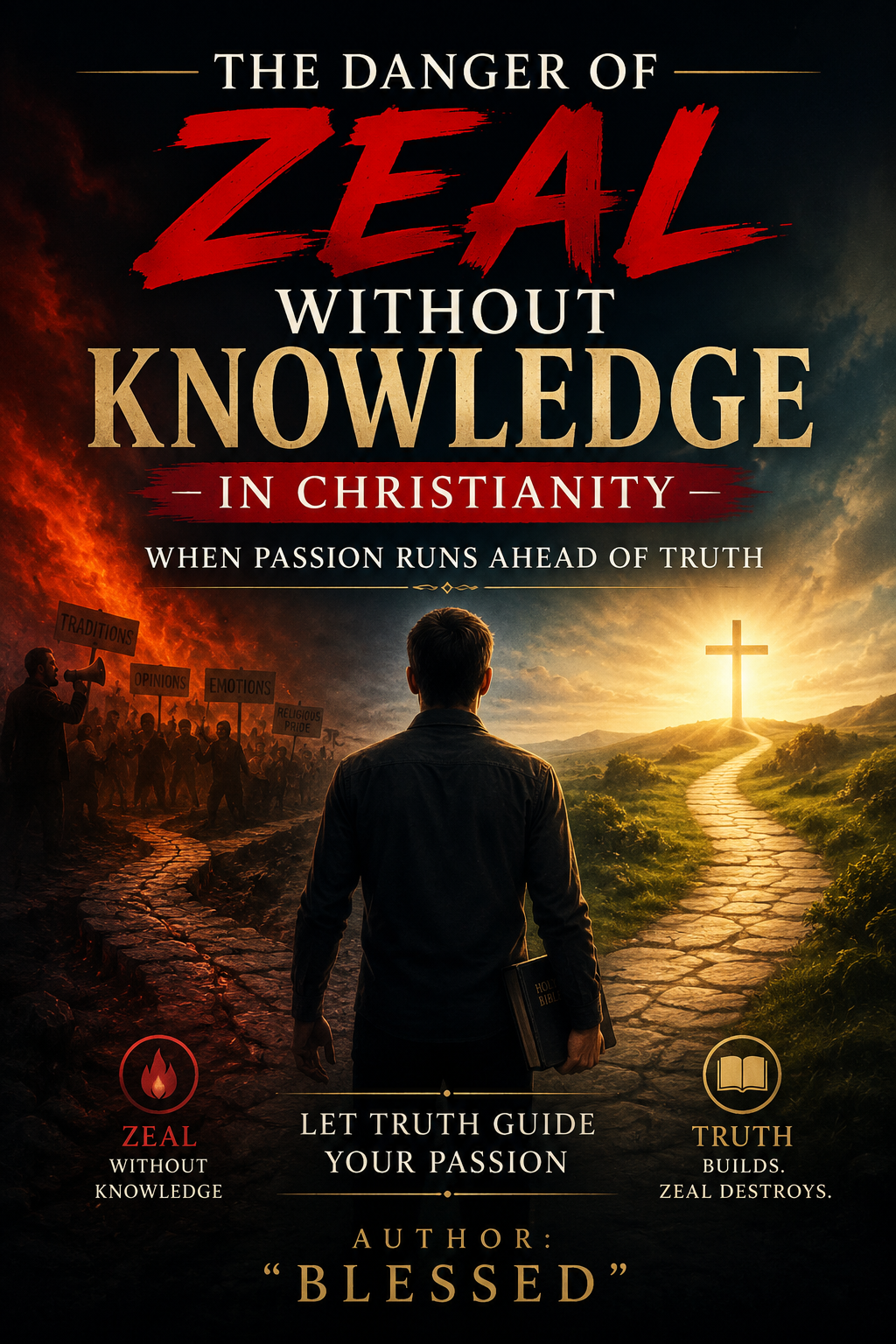
Introduction: Passion Is Powerful—But Is It Enough?
Passion is one of the most powerful forces in human life. It drives people to pursue dreams that seem impossible, overcome obstacles that would stop others, and devote themselves completely to causes they believe are worth every sacrifice. Throughout history, passionate men and women have changed nations and left legacies that outlived them by centuries.
The same is true within the Church. We rightly admire believers who pray fervently, worship wholeheartedly, evangelize boldly, and serve faithfully. A heart on fire for God always appears more attractive than one that has grown cold, indifferent, or spiritually asleep.
Yet every believer must eventually answer an important question: Can passion alone keep you on the right path? Scripture gives a sobering answer. In Romans 10:2, the Apostle Paul writes concerning his fellow Israelites:
“For I bear them witness that they have a zeal for God, but not according to knowledge.”
Pause and consider that for a moment. These were not people who hated God. They were not atheists, cynics, or spiritually lazy individuals. They were sincere, devoted, and deeply religious. Yet despite all their dedication, they were moving in a direction God never intended. Their zeal had outrun their understanding, and the gap between the two became the very thing preventing them from recognizing the Messiah they had waited centuries to receive.
That same danger still exists in the Church today. Many believers genuinely love God and desire to serve Him faithfully. However, good intentions alone have never been enough. A person can be completely sincere and still be mistaken. They can be deeply devoted and still find themselves pursuing something God never asked them to pursue.
This article is not written to discourage passion. Christianity desperately needs more passion, not less. Rather, it is written to show why passion must be anchored in truth if it is going to produce lasting spiritual fruit. When passion and truth walk together, spiritual maturity follows. But when passion runs ahead of truth, even the most sincere believer can slowly drift into error without realizing it.
What Does “Zeal Without Knowledge” Mean?
Zeal is intense enthusiasm, commitment, and devotion expressed through action. It is the fire that motivates people to pray, serve, worship, and sacrifice. Knowledge, in the biblical sense, is far more than information stored in the mind. It is a genuine understanding of God’s truth that shapes the way a person thinks, lives, and responds to life.
Zeal without knowledge occurs when passion operates without biblical guidance. It happens when emotions take the lead and truth struggles to keep up. It appears whenever someone becomes more attached to personal experiences, inherited traditions, or strong feelings than to what Scripture actually teaches. On the surface, this kind of zeal can be impressive—it attracts attention, generates excitement, and creates momentum. In some cases, it may even appear highly spiritual. Yet beneath the surface, something essential may be missing: truth.
Imagine a powerful car speeding down a highway at full speed. The engine is strong, the vehicle is impressive, and the momentum is undeniable. But if the driver is heading in the wrong direction, speed becomes a liability rather than an advantage. The faster the car travels, the farther it moves from its intended destination. The same principle applies spiritually—passion without truth does not make error harmless. More often, it causes error to spread faster and reach farther.
Sincerity Is Not the Same as Truth
One of the most common misconceptions among Christians is the belief that sincerity automatically guarantees correctness. Many assume that if their heart is in the right place, their actions must also be pleasing to God. Scripture never teaches this.
Imagine someone taking medication without reading the dosage instructions. They genuinely want to get better, and their intentions are good. However, sincerity cannot protect them from the consequences of taking the wrong dosage. Good intentions cannot change reality.
Likewise, spiritual sincerity cannot replace biblical truth. This is why believers are repeatedly called to examine what they believe, practice, and experience in the light of God’s Word. Truth is not determined by the intensity of our feelings—it is determined by what God has revealed. Our emotions may be sincere, and our convictions may feel strong, yet if they are not grounded in Scripture, they can still lead us astray.
Three Biblical Examples of Misguided Zeal
1. Saul: Devout, Determined, and Tragically Wrong
Before becoming the Apostle Paul, Saul was one of the most zealous religious men of his generation. He was not indifferent toward God, nor was he pretending to be faithful. He was fully convinced that he was defending God’s honor. Because of that conviction, Saul persecuted Christians relentlessly, approving of their imprisonment and actively working to destroy the early Church.
His zeal was genuine, but it was tragically misdirected. While believing he was serving God, he was actually opposing the very work God was accomplishing through Jesus Christ. Everything changed on the road to Damascus when Saul encountered the risen Lord, and his passion was finally brought into alignment with truth.
His story reminds us that the most dangerous errors are often embraced by sincere people who are absolutely convinced they are right.
2. Peter: Loyal, Courageous, and Still Missing the Point
Peter’s love for Jesus was never in doubt. He left everything to follow Christ, openly declared his loyalty, and repeatedly demonstrated his willingness to sacrifice for his Lord. When soldiers arrived in the Garden of Gethsemane to arrest Jesus, Peter reacted immediately, drawing his sword and striking one of the men who had come to take Jesus away.
At first glance, Peter’s actions appear admirable—he was courageous, loyal, and ready to fight for the One he loved. Yet Jesus rebuked him. Why? Because Peter’s passion had moved ahead of his understanding. He viewed the arrest as a tragedy that needed to be prevented, while Jesus saw it as part of the Father’s plan for humanity’s redemption. Peter’s heart was devoted to Christ, but his actions were out of step with God’s purpose.
This is one of the clearest examples of how zeal without knowledge can operate. The problem was not Peter’s love—it was that his love had not yet been fully shaped by God’s wisdom. Many believers today make similar mistakes: they act with sincere motives, yet without fully understanding what God is doing. Good intentions alone are not enough. Passion must be guided by truth.
3. The Pharisees: Religious, Disciplined, and Still Missing the Messiah
The Pharisees are often remembered as villains in the Gospel accounts, but the reality is more complex. Many of them were deeply committed to their faith, devoting themselves to studying Scripture, maintaining religious standards, and preserving the traditions of their people. Their discipline would challenge many modern Christians—they memorized large portions of Scripture, took their religious responsibilities seriously, and were willing to make personal sacrifices for what they believed.
Yet when Jesus, the very Messiah foretold in the Scriptures they studied, stood before them, many rejected Him. Why? Because their zeal had become attached to tradition rather than truth. They had become so focused on preserving their religious systems that they failed to recognize the One those systems were meant to reveal.
Their story carries a powerful warning: it is possible to become so committed to religious habits, traditions, and routines that we lose sight of Christ Himself. Religious activity is valuable, but only when it points us toward God. When tradition becomes more important than truth, zeal becomes dangerous.
How Zeal Without Knowledge Appears in Christianity Today
This problem did not disappear after the first century. It continues to appear in churches, ministries, and individual believers around the world.
Following Personalities Instead of Scripture Some believers accept teaching simply because it comes from a popular preacher, influential leader, or charismatic speaker. The assumption is that confidence equals accuracy, but confidence and truth are not the same thing. The believers in Berea were praised because they examined the Scriptures daily to verify what they were being taught. They did not reject teaching, but neither did they accept it blindly. Every believer must do the same—no preacher, pastor, teacher, or ministry should ever replace personal engagement with God’s Word.
Elevating Experiences Above Scripture: God still works powerfully today. He heals, guides, convicts, comforts, and transforms lives. However, personal experiences are not infallible—people can misunderstand what they experience, emotions can influence interpretation, and circumstances can distort perception. When experience becomes the final authority, believers become vulnerable to deception. Scripture must always remain the standard by which every experience is evaluated. God’s Word judges our experiences; our experiences should never judge God’s Word.
Mistaking Activity for Spiritual Growth: Many Christians are constantly busy. They attend every meeting, volunteer for every event, and fill their schedules with church activities. Yet despite all that movement, genuine spiritual growth may be minimal. A crowded calendar is not proof of maturity. A person can be active in ministry while neglecting prayer, serve faithfully while rarely opening their Bible, and stay busy for God while quietly drifting away from intimacy with Him. Activity is not the same as transformation—growth occurs when zeal is combined with a growing knowledge of God and His Word.
Defending Traditions More Than Truth Traditions can be valuable. Many exist because generations of believers discovered practices that helped strengthen faith. The problem arises when traditions become untouchable. Whenever tradition is placed above Scripture, zeal begins moving in the wrong direction. A believer’s highest loyalty must always belong to God’s Word. Traditions should serve truth, not replace it.
Why Zeal Without Knowledge Is So Dangerous
It opens the door to deception. Passionate people are often confident people. Confidence rooted in truth is a tremendous strength, but confidence rooted in error is a serious danger. The more convinced a person becomes of a false idea, the more difficult it becomes for them to recognize and correct it. This is why humility and teachability are essential for spiritual growth.
It influences others. Spiritual error rarely remains private. False teaching spreads, poor advice gets repeated, and misunderstandings become accepted beliefs. A believer operating with passion but lacking wisdom may unintentionally lead others astray. This is why every Christian has a responsibility to pursue both truth and maturity.
It creates unnecessary division. When passion outruns understanding, conversations often become arguments. People become more interested in winning debates than in helping others grow. Minor issues become major battles, and relationships and churches suffer as a result. Knowledge joined with humility builds unity; zeal without wisdom often produces conflict.
It distorts the world’s view of Christ. The world watches Christians closely, and people often form opinions about Jesus based on the behavior of those who claim to follow Him. When believers act recklessly, speak carelessly, or promote error with great enthusiasm, they can unintentionally create a distorted picture of Christ. Many people have rejected Christianity not because they encountered Jesus, but because they encountered misguided zeal presented in His name. This should concern every believer.
The Other Extreme: Knowledge Without Zeal
While zeal without knowledge is dangerous, the opposite imbalance is equally harmful. Some believers possess impressive biblical knowledge—they understand doctrine, can explain theology clearly, and know the right answers to difficult questions. Yet their hearts have grown cold, and their faith has become intellectual rather than relational. Knowledge without love often leads to pride, and truth without passion can become cold, mechanical, and ineffective.
God never intended believers to choose between knowledge and zeal. He desires both: minds rooted in truth and hearts that burn with love for Him. The healthiest Christians are not those who have passion without understanding or understanding without passion—they are those who cultivate both.
Five Practical Ways to Balance Zeal and Knowledge
- Make Scripture your foundation. Opinions change. Culture changes. Popular teachings come and go. God’s Word remains unchanged. Every belief, experience, and conviction should be measured against Scripture, because a believer grounded in God’s Word is far less vulnerable to deception.
- Remain teachable. Spiritual maturity includes the willingness to be corrected. Pride resists instruction; humility welcomes it. A teachable believer understands that growth is a lifelong process and that there is always more to learn.
- Ask God for wisdom. Knowledge alone is not enough. Believers also need wisdom—the ability to apply truth correctly in real-life situations. James encourages Christians to ask God for wisdom, and God promises to give generously to those who ask in faith.
- Welcome, godly accountability. No one sees themselves perfectly. God often uses pastors, mentors, mature believers, and trusted friends to reveal blind spots we cannot see on our own. Wise Christians invite accountability rather than avoiding it.
- Focus on knowing Christ. The ultimate goal of Christianity is not accumulating information—it is knowing Jesus Christ. As believers grow closer to Him, both knowledge and zeal develop naturally, producing a faith that is both passionate and grounded.
A Personal Heart Check
Take a moment to ask yourself these questions honestly:
- Do I react emotionally before examining what Scripture says?
- Do I accept teachings without personally verifying them in God’s Word?
- Am I more loyal to traditions than to biblical truth?
- Do I become defensive when someone respectfully challenges my beliefs?
- Am I relying more on feelings than on Scripture?
- Am I passionate about Christianity while neglecting time in God’s Word?
These questions are not meant to produce guilt—they are meant to encourage reflection. Recognizing a weakness is often the first step toward overcoming it, and God is patient with sincere believers who desire to grow.
A Call to Spiritual Maturity
The Church has never lacked passion. What it often lacks is passion firmly anchored in truth. God is looking for believers who love Him deeply and know His Word well—Christians whose passion is fueled by truth and whose knowledge is warmed by genuine devotion.
The strongest believers are not those who choose between zeal and knowledge. They are those who embrace both. Their understanding strengthens their passion, and their passion drives them deeper into truth. Together, these qualities create a powerful witness in a confused and searching world.
Conclusion: Let Truth Guide Your Passion
Zeal is a gift from God. A heart that burns for Christ should never be discouraged. The problem is not passion itself—the problem is passion that has become disconnected from truth.
Throughout Scripture, one lesson appears repeatedly: sincerity alone is not enough. A person can be deeply committed, completely confident, and still be mistaken. That is why God’s Word must always guide our enthusiasm. As you continue your walk with Christ, pursue more than emotional excitement. Seek understanding. Pursue wisdom. Remain humble and teachable, and welcome correction when necessary. Keep your passion for God alive and strong.
Most importantly, allow God’s truth—not feelings, traditions, culture, or popular opinion—to direct your zeal. May your heart burn passionately for Christ while remaining firmly rooted in His Word.
The pursuit of truth is not only essential for spiritual maturity; it is also essential for personal freedom. Knowledge protects, guides, and empowers those who seek it diligently. To continue exploring this important theme, read “Knowledge Makes a Man Unfit for Slavery: The Power of an Awakened Mind.
Prayer Lord, I do not want my passion for You to run ahead of Your truth. Anchor my zeal in genuine understanding. Help me grow in wisdom, humility, and spiritual maturity. Let my knowledge of You deepen my love for You, and let my love for You drive me deeper into Your truth. May my life reflect both the passion and wisdom of Christ. In Jesus’ name, Amen.
As you move through this week, spend intentional time in Scripture. Ask God to strengthen both your passion and your understanding. When zeal and knowledge walk together, spiritual maturity is never far behind.
If this article encouraged you, consider sharing it with someone who may benefit from it. You are also welcome to share your thoughts and reflections in the comments below.