
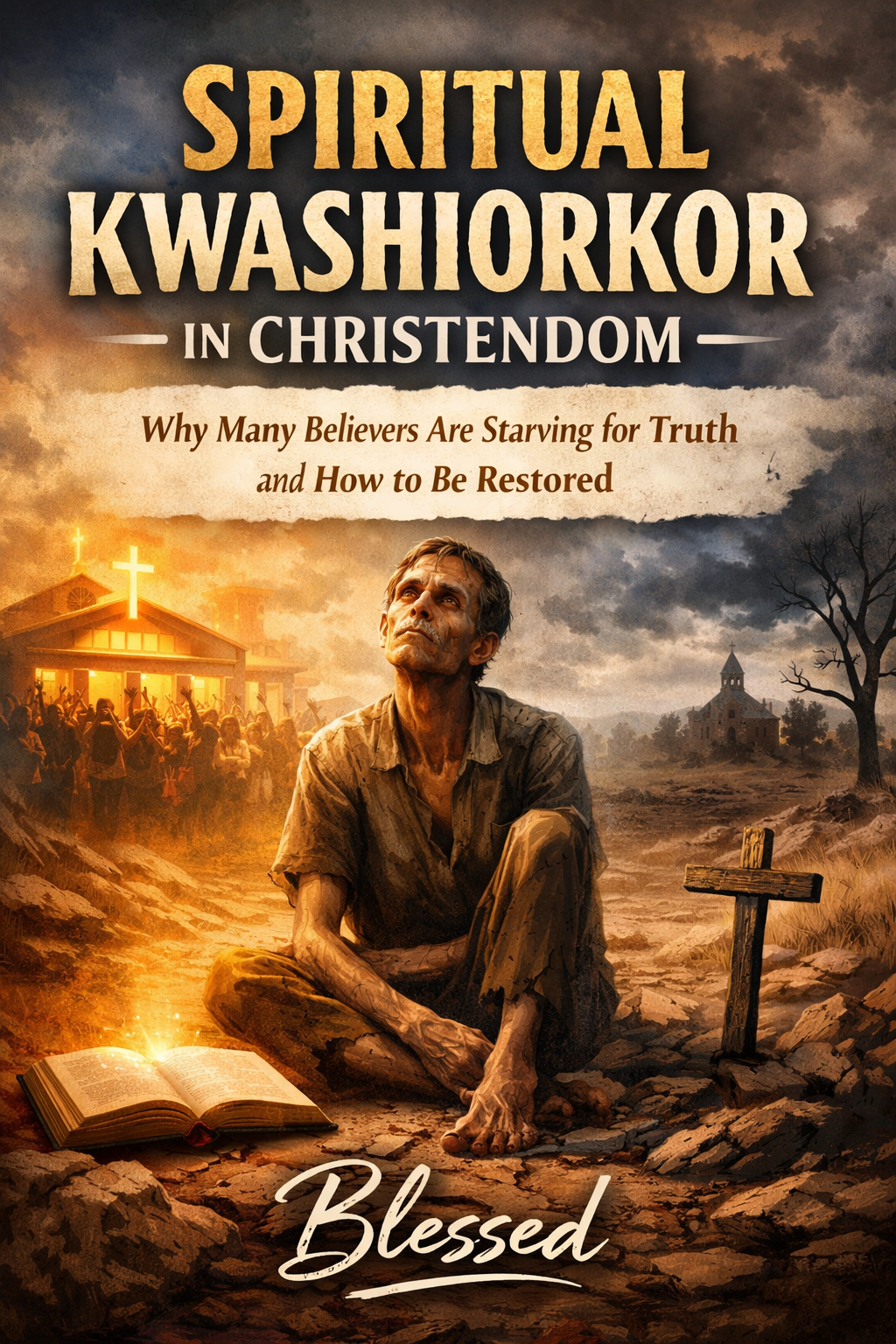
A Disease Nobody Talks About in Church
There is a medical condition called kwashiorkor—a severe form of protein deficiency that can be deceptive.
From a distance, the affected person may not appear visibly starved. In some cases, the body even looks swollen or well-fed. Yet beneath the surface, muscles are wasting away, vital organs are weakening, and the body is experiencing a silent crisis.
Now consider a spiritual parallel that is unfolding in churches around the world.
Congregations are full.
Worship services are louder than ever.
Social media is flooded with scriptures, declarations, sermons, and religious content.
Yet quietly—almost invisibly—many believers are experiencing what can only be described as spiritual malnutrition.
This is what we might call Spiritual Kwashiorkor: the condition of appearing spiritually active on the outside while remaining deeply undernourished in the truth of God’s Word.
People attend services but remain spiritually hungry.
They sing in choirs but feel empty within.
They quote scriptures but lack true understanding.
This is not primarily a church attendance problem.
It is a spiritual nourishment problem.
What Exactly Is Spiritual Kwashiorkor?
Physical kwashiorkor develops not simply because a person eats too little food, but because they consume food that lacks the nutrients their body truly needs.
The stomach may be full, but the body is starving.
Spiritual kwashiorkor works in much the same way.
A believer may consume large amounts of religious content—Sunday services, worship playlists, motivational messages, podcasts, and social media devotionals—yet still remain spiritually weak.
The intake appears sufficient.
The deficiency runs deep.
True spiritual nourishment comes through consistent, personal, and thoughtful engagement with God’s Word—not merely through passive exposure to religious activity.
When that personal connection is absent, a believer can become active in religion while remaining weak in faith.
What Causes Spiritual Kwashiorkor?
Several factors contribute to spiritual malnutrition among believers.
1. Neglect of Personal Bible Study
Many Christians rely almost entirely on sermons and devotionals while neglecting personal study of Scripture.
They seek quick inspiration rather than deep understanding.
2. Excessive Consumption of Spiritual “Junk Food.”
Hours are spent on entertainment, endless scrolling, and distractions, while very little time is invested in God’s Word.
What feeds the mind eventually shapes the soul.
3. Superficial Church Experiences
Some church environments focus heavily on activities, programs, and excitement but place less emphasis on discipleship, biblical literacy, and spiritual maturity.
4. Lack of Genuine Discipleship
Many people are converted but never truly discipled.
They begin the Christian journey but are not taught how to grow spiritually.
5. Spiritual Laziness
Growth requires discipline.
Prayer requires discipline.
Bible study requires discipline.
Many desire spiritual maturity without embracing the habits that produce it.
Six Signs You May Be Spiritually Malnourished
Spiritual malnutrition rarely happens overnight.
It develops gradually, making it difficult to recognize.
1. Your Knowledge of Scripture Is Mostly Surface-Level
You can quote popular verses and recognize familiar passages.
However, when difficult questions arise or someone challenges your beliefs, you struggle to explain what Scripture actually teaches.
The Bible feels familiar, but not deeply understood.
2. Your Faith Rises and Falls With Your Emotions
On Sunday, surrounded by worship and encouragement, your faith feels strong.
By Wednesday, life’s pressures have drained your confidence.
Spiritually nourished believers are anchored in truth.
Spiritually malnourished believers often become anchored in feelings.
3. You Depend Almost Entirely on Others for Spiritual Input
Pastors, teachers, books, and podcasts are valuable.
The danger comes when they become your only source of spiritual growth.
If your spiritual health depends entirely on what someone else feeds you, you become vulnerable when that source disappears, disappoints you, or teaches error.
4. You Struggle to Recognize False Teaching
Spiritual maturity develops discernment.
A believer rooted in Scripture can distinguish truth from teachings that merely sound convincing.
When spiritual malnutrition sets in, discernment weakens.
5. Prayer Feels Like an Obligation Rather Than a Relationship
For a spiritually healthy believer, prayer is living communication with God.
For a spiritually malnourished believer, prayer often becomes mechanical, infrequent, and lifeless.
It feels like a duty rather than a relationship.
6. Small Temptations Keep Winning
Just as physical nourishment strengthens the body, spiritual nourishment strengthens the soul.
A believer consistently fed by God’s Word develops resilience.
A spiritually starving believer often finds themselves repeatedly falling into patterns they genuinely want to overcome.
The Danger of Remaining Spiritually Malnourished
Spiritual kwashiorkor is dangerous because its effects are often hidden.
A believer may still look active, committed, and religious on the outside while slowly weakening within.
Over time, spiritual malnutrition can lead to:
- Weak faith during trials
- Confusion about biblical truth
- Vulnerability to deception
- Loss of spiritual identity
- Reduced discernment
- Persistent compromise with sin
- Spiritual dryness and coldness toward God
The tragedy is that many believers do not realize what is happening until they face a major spiritual challenge and discover they lack the strength to stand.
How to Recover From Spiritual Kwashiorkor
The good news is that spiritual malnutrition is reversible.
Healing is possible.
1. Return to Daily Intake of God’s Word
Treat Scripture as daily nourishment rather than occasional inspiration.
Start small but remain consistent.
Read regularly.
Meditate thoughtfully.
Seek understanding rather than speed.
2. Build a Personal Study Habit
Move beyond simply reading verses.
Ask questions:
- What does this passage mean?
- What does it reveal about God?
- How does it apply to my life?
- What should I obey?
3. Strengthen Your Prayer Life
Prayer is not merely a religious activity.
It is fellowship with God.
Develop a rhythm of communication with Him throughout the day.
Consistency matters more than length.
4. Reduce Spiritual Junk Food
Evaluate what fills your mind.
Limit content that constantly distracts you from God’s truth.
Not everything that entertains you nourishes you.
5. Connect With Healthy Discipleship Communities
Growth thrives in environments of accountability, encouragement, and biblical truth.
Surround yourself with believers who challenge you to mature spiritually.
6. Practice What You Learn
Information alone does not produce growth.
Obedience does.
The Word becomes life-giving when it is applied.
Do not merely hear the Word.
Live it.
A Call to Deep Spiritual Renewal
God is not looking merely for active church members.
He is seeking believers who are deeply rooted, spiritually nourished, and grounded in truth.
Spiritual kwashiorkor is not a final condition.
It is a warning sign.
A loving invitation from God to return to depth, discipline, and devotion.
You were never designed to survive on fragments of truth.
You were created to be strengthened by the fullness of God’s Word.
Conclusion: It Is Time to Be Restored
The body of Christ does not need more shallow excitement.
It needs deep transformation.
If you feel spiritually dry, weak, confused, or disconnected, the answer is not complicated.
Return to the Word.
Return to prayer.
Return to truth.
Because healing begins the moment you stop starving your spirit and start feeding it again.
A healthy church is not merely a full church.
A healthy church is filled with believers who are growing, discerning, rooted, and spiritually nourished in Christ.