
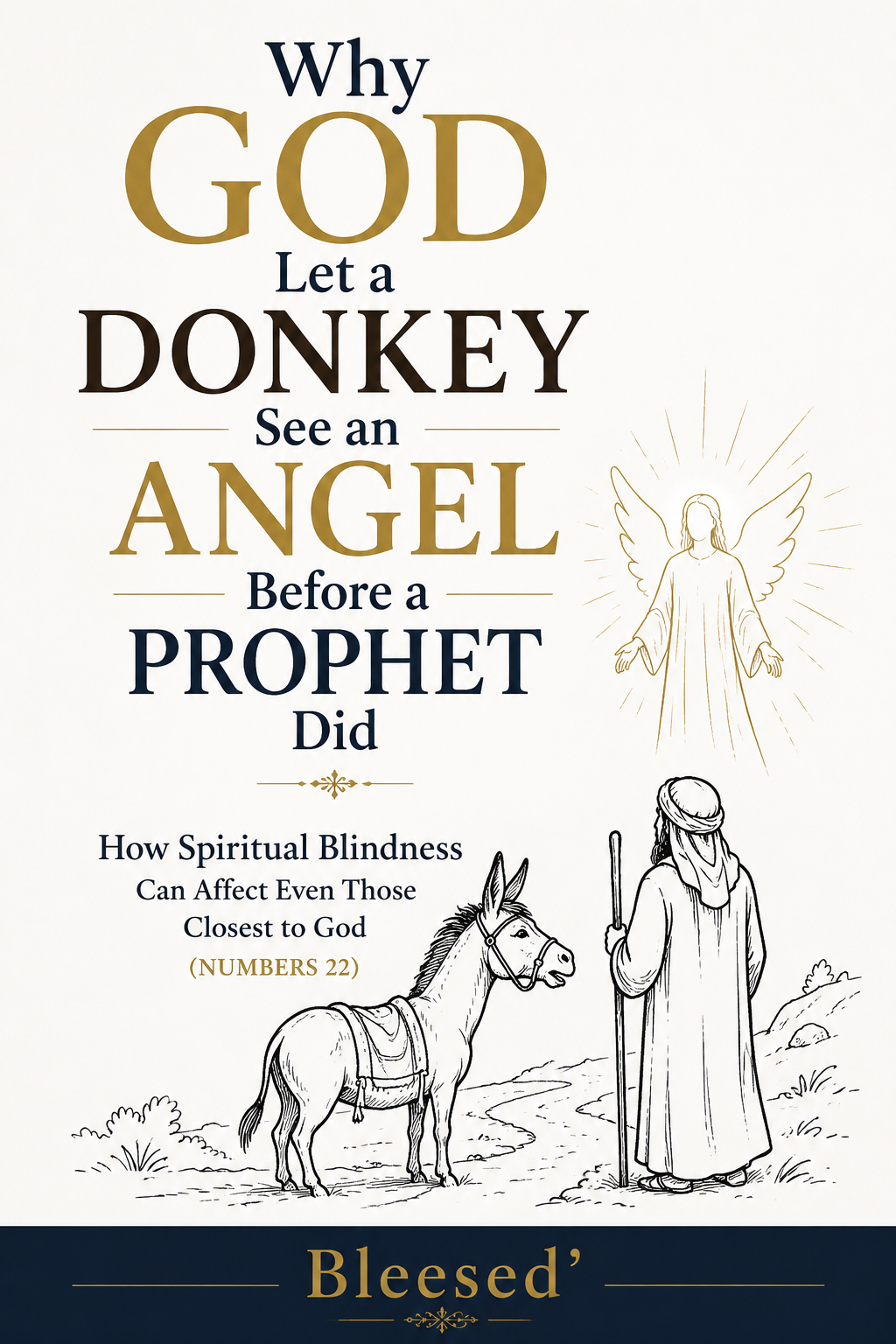
How Spiritual Blindness Can Affect Even Those Closest to God (Numbers 22)
Introduction
Few stories in the Bible are as surprising as the account of Balaam and his donkey.
Imagine a respected prophet traveling down a familiar road. He has heard God’s voice before. He has delivered prophecies. Kings seek his counsel, and people recognize him as a man with spiritual insight.
Yet on this particular journey, something extraordinary happens.
A donkey sees what the prophet cannot.
An angel of the Lord stands directly in the road with a drawn sword, but Balaam keeps riding as if nothing is there. The donkey stops, turns aside, presses against a wall, and finally lies down—all because it can see the danger that its master cannot.
It is one of the most remarkable moments in Scripture.
God allows a humble animal to recognize His messenger before a prophet does.
At first, the story may seem like nothing more than an unusual miracle involving a talking donkey. But beneath the surface lies a powerful warning for every believer.
It teaches that spiritual blindness can affect even people who have walked with God for years.
It reminds us that gifts do not replace obedience.
Experience does not guarantee discernment.
Past victories do not ensure present faithfulness.
Perhaps you have wondered why certain opportunities suddenly disappeared, why your plans kept falling apart, or why someone close to you sensed danger long before you did.
Could those interruptions have been acts of God’s mercy?
Could the delays you resisted have actually been God’s protection?
The story of Balaam challenges us to ask an uncomfortable question:
What if the greatest danger is not that God has stopped speaking—but that we have stopped listening?
Before God opened Balaam’s eyes, He opened the mouth of a donkey.
Before the prophet understood what was happening, an ordinary animal recognized heaven’s warning.
That truth should humble every one of us.
Because sometimes God chooses the most unexpected voice to keep us from the greatest mistake of our lives.
The Man Who Heard God—But Stopped Listening
The story begins in Numbers 22 when Balak, king of Moab, became terrified of Israel’s growing strength. Convinced that military power alone would not defeat them, he turned to a man named Balaam—a prophet known for speaking blessings and curses that people believed came to pass.
Balak sent respected officials with generous rewards, asking Balaam to curse God’s people.
At first, Balaam did the right thing.
He sought the Lord.
God’s answer was unmistakably clear.
“Thou shalt not go with them; thou shalt not curse the people: for they are blessed.” — Numbers 22:12 (KJV)
There was no confusion.
No hidden meaning.
No room for negotiation.
God had spoken.
For most people, that should have settled the matter.
But it did not settle it for Balaam.
When Balak sent even more distinguished officials with promises of greater honor and richer rewards, Balaam entertained the offer again. Instead of resting in God’s clear command, he returned to the same question.
His heart was beginning to drift.
The temptation was no longer simply about obeying God.
It was about what he might gain if things turned out differently.
This is often how spiritual compromise begins.
Rarely does someone wake up one morning intending to rebel against God.
Instead, the process starts quietly.
A desire becomes stronger than obedience.
A personal ambition begins to compete with God’s will.
We start hoping that perhaps God will change His mind because we do not want to change ours.
Many believers still make the same mistake today.
God speaks clearly through His Word.
Yet we continue asking Him the same question, hoping that repeated prayers will produce a different answer.
We pray again.
We seek another opinion.
We look for another sign.
Not because God’s will is unclear, but because our hearts are reluctant to accept it.
There is an important difference between seeking God’s guidance and trying to negotiate with His instructions.
Faith seeks understanding.
Disobedience seeks permission.
Balaam was not struggling to hear God’s voice.
He was struggling to accept what God had already said.
That is a dangerous place for any believer.
The more we resist God’s truth, the easier it becomes to ignore His warnings.
Little by little, our spiritual sensitivity begins to fade.
We may still attend church.
We may still pray.
We may still know Scripture.
Others may even admire our spiritual maturity.
Yet inwardly, our hearts can slowly drift away from simple obedience.
Balaam still carried the title of prophet.
But titles do not protect anyone from spiritual blindness.
Knowledge cannot replace humility.
Spiritual gifts cannot replace submission.
Balaam’s experience proves that spiritual gifts alone cannot prevent spiritual blindness. To understand why a close relationship with God is far more important than the gifts He gives, don’t miss our related article: Spiritual Gifts vs Physical Gifts of God: Understanding What Matters Most.
A history with God cannot substitute for a present willingness to obey Him.
The tragedy of Balaam’s story is not that God stopped speaking.
The tragedy is that Balaam’s desires gradually became louder than God’s voice.
That is why every believer should regularly ask:
Am I still listening to God, or am I only listening for the answer I want to hear?
That single question can reveal whether our hearts are moving closer to God—or quietly drifting away from Him.
The Donkey Saw What the Prophet Missed
As Balaam set out on his journey, everything probably seemed normal.
He had his destination in mind.
He had influential men traveling with him.
He believed he was moving toward an opportunity that promised honor and reward.
But there was one problem.
God knew something Balaam did not.
The Bible says:
“And God’s anger was kindled because he went: and the angel of the Lord stood in the way for an adversary against him.” — Numbers 22:22 (KJV)
Notice that Balaam could not see the angel.
But his donkey could.
“And the ass saw the angel of the Lord standing in the way, and his sword drawn in his hand.” — Numbers 22:23 (KJV)
That single sentence changes everything.
The prophet was blind.
The donkey could see.
The one who was expected to possess spiritual discernment had none at that moment.
The animal with no prophetic calling recognized heaven’s warning immediately.
Three different times, the donkey saw the angel.
The first time, she turned off the road into a field.
Balaam became angry and struck her.
The second time, the angel stood in a narrow path between vineyards.
Trying to avoid the angel, the donkey pressed against a wall and crushed Balaam’s foot.
Instead of asking why his faithful animal was behaving so strangely, Balaam hit her again.
The third time, the angel stood where there was nowhere left to turn.
The donkey simply lay down beneath Balaam.
Again, Balaam responded with anger instead of reflection.
He never stopped to ask,
“Why is my donkey acting this way?”
He assumed the problem was the donkey.
In reality, the problem was himself.
How often do we make the same mistake?
When life refuses to move in the direction we expect, we blame the circumstances.
We blame people.
We blame delays.
We blame disappointments.
Sometimes we even blame God.
Yet we rarely stop long enough to ask,
“Lord, are You trying to show me something that I cannot yet see?”
Balaam interpreted every interruption as an inconvenience.
God intended each interruption as an act of mercy.
There is a profound lesson here.
Being spiritually gifted does not guarantee spiritual clarity.
Someone may preach powerful sermons and still miss God’s warning.
Someone may teach Bible studies and still ignore the Holy Spirit’s conviction.
Someone may have years of ministry experience yet become blinded by pride, ambition, greed, or self-interest.
Past experiences with God do not eliminate our daily need to walk humbly before Him.
The donkey had no prophetic gift.
No title.
No reputation.
Yet in that moment, she recognized the presence of God more clearly than the prophet riding on her back.
That should humble every believer.
God is not impressed by our titles.
He looks at our hearts.
When We Become Spiritually Blind Without Realizing It
One of the greatest dangers in the Christian life is that spiritual blindness rarely announces itself.
People who are spiritually blind usually do not know they are blind.
Neither did Balaam.
He believed he was moving in the right direction.
He probably thought God was blessing his journey.
Meanwhile, an angel with a drawn sword stood directly in his path.
That is what makes spiritual blindness so dangerous.
It allows us to move confidently in the wrong direction.
Perhaps this has happened in your own life.
Maybe God clearly warned you about a relationship, but you convinced yourself it would work out anyway.
Perhaps He spoke through His Word about a business decision, yet the promise of financial gain seemed too attractive to ignore.
Maybe He prompted you to forgive someone, confess a hidden sin, or walk away from a compromise, but you kept delaying your obedience.
Nothing dramatic happened overnight.
Your heart simply became less sensitive.
That is how spiritual blindness develops.
It begins with one ignored conviction.
Then another.
Soon, what once troubled your conscience hardly affects you at all.
Many believers continue attending church while quietly drifting from God’s will.
They still worship.
They still pray.
They still read the Bible.
Outwardly, everything appears healthy.
Inwardly, however, they are no longer responding to God’s voice with the same humility they once had.
That is why Proverbs 16:25 gives this solemn warning:
“There is a way that seemeth right unto a man, but the end thereof are the ways of death.”
Our greatest danger is not always obvious sin.
Sometimes it is sincere confidence in a path God never approved.
Balaam did not need another prophecy.
He needed open eyes.
The same is true for us.
Before asking God to bless our plans, we should ask Him to reveal whether they truly align with His will.
It is far better to experience a delayed blessing than to rush ahead without God’s approval.
God Opened the Donkey’s Mouth Before He Opened Balaam’s Eyes
Then the story becomes even more remarkable.
After Balaam struck the donkey for the third time, God performed one of the most unusual miracles recorded in Scripture.
“And the Lord opened the mouth of the ass, and she said unto Balaam, What have I done unto thee, that thou hast smitten me these three times?” — Numbers 22:28 (KJV)
Think about what happened.
God gave the donkey a voice…
Before He gave the prophet spiritual sight.
That detail is impossible to ignore.
Before Balaam could see the angel,
The donkey spoke.
Before the prophet understood the danger,
God used the lowest and least expected creature to confront his pride.
This was not God humiliating Balaam.
It was God showing extraordinary patience.
The Lord could have allowed Balaam to continue toward judgment.
Instead, He interrupted him.
He warned him.
He confronted him.
He even performed a miracle simply to get his attention.
That is mercy.
God still works this way today.
Sometimes He speaks through people we least expect.
A child asks an honest question that exposes our compromise.
A new believer notices something experienced Christians have overlooked.
A faithful spouse raises a concern we would rather ignore.
A trusted friend lovingly warns us that we are making a mistake.
Even unexpected delays, disappointments, or closed doors can become God’s way of saying,
“Stop. Look again.”
Pride asks,
“Why should I listen to them?”
Humility asks,
“Could God be speaking through them?”
The issue has never been whether God is able to speak.
The issue is whether we are willing to listen.
If God could use a donkey to rescue a prophet from disaster, He can certainly use ordinary people and ordinary circumstances to guide us today.
Never dismiss God’s message simply because it comes through an unexpected messenger.
God often chooses unlikely instruments to accomplish extraordinary purposes.
Perhaps the interruption is frustrating you today..It
is actually the mercy that will save you tomorrow.
When God Finally Opened Balaam’s Eyes
After the donkey spoke, the Lord did something Balaam had needed from the beginning of his journey.
He opened his eyes.
“Then the Lord opened the eyes of Balaam, and he saw the angel of the Lord standing in the way, and his sword drawn in his hand: and he bowed down his head, and fell flat on his face.” — Numbers 22:31 (KJV)
Notice something remarkable.
The angel had not just arrived.
The angel had been standing there all along.
Nothing about the situation had changed.
Only Balaam’s ability to see had changed.
That is often how God works in our lives.
Sometimes we pray,
“Lord, change my circumstances.”
But God first wants to change our perspective.
We ask Him to remove every obstacle.
He asks us to examine the path we are taking.
The angel then revealed why he had blocked Balaam’s journey.
“Behold, I went out to withstand thee, because thy way is perverse before me.” — Numbers 22:32 (KJV)
This is one of the most sobering statements in the story.
God was not trying to destroy Balaam.
He was trying to stop him.
The obstacle in the road was not punishment.
It was protection.
Without God’s intervention, Balaam would have continued down a path that would eventually bring judgment upon himself.
How many times have we mistaken God’s protection for His opposition?
We complain about the closed door.
We become frustrated by the delay.
We become discouraged when our plans collapse.
Yet years later, we look back and thank God that He did not allow us to continue.
What felt like rejection was actually rescue.
What looked like disappointment became divine protection.
Sometimes the greatest blessing God gives us is not an open door.
It is the wisdom to recognize why He closed one.
Why God Speaks Through Unexpected People
One of the greatest lessons from Balaam’s story is that God is not limited by the messenger He chooses.
He spoke through a burning bush to Moses.
He spoke through a young shepherd named David.
He spoke through fishermen who became apostles.
And in Balaam’s case, He spoke through a donkey.
Why?
Because God’s authority does not depend on the status of His messenger.
It depends on His power.
Sometimes we expect God to speak only through famous preachers, respected leaders, or people with impressive spiritual credentials.
Yet God often chooses unexpected voices to capture our attention.
A child may ask a question that exposes our pride.
A new believer may remind us of simple truths we have neglected.
A faithful spouse may lovingly confront a blind spot we refuse to acknowledge.
Even an unbeliever may make an observation that causes us to reconsider our direction.
The issue is never whether God can use them.
The question is whether we are humble enough to listen.
This does not mean we accept every opinion as God’s voice.
Every message must be tested against Scripture.
God will never contradict His written Word.
However, we should never reject truth simply because it comes from someone unexpected.
Pride says,
“God wouldn’t speak through someone like that.”
Humility says,
“Lord, if You are speaking, help me to hear.”
A teachable spirit is one of the greatest signs of spiritual maturity.
Practical Lessons
The story of Balaam is more than an interesting Bible account.
It is a mirror that invites us to examine our own hearts.
1. Don’t negotiate with God’s clear commands.
If God has already spoken through His Word, repeated prayers will not change His truth.
Obedience begins where excuses end.
2. Be careful when desire becomes louder than conviction.
Many spiritual failures begin with a heart that wants something more than it wants to obey God.
Ask yourself regularly:
“Am I pursuing God’s will—or simply asking God to approve mine?”
3. Pay attention to God’s interruptions.
Not every delay is from Satan.
Not every closed door is an attack.
Sometimes God’s greatest act of love is stopping us before we make a costly mistake.
4. Stay humble enough to receive correction.
God may use a pastor.
He may use your spouse.
He may use a close friend.
He may even use someone you least expect.
Never ignore wise, biblical counsel simply because it comes from an unexpected source.
5. Pray for open eyes before open doors.
Many people spend their lives asking God for opportunities.
Few ask Him for discernment.
Spiritual sight is far more valuable than worldly success.
6. Remember that God’s delays are often expressions of His mercy.
What seems like frustration today may become tomorrow’s testimony.
Trust God’s timing, even when you do not understand His methods.
A Prayer for Spiritual Discernment
Heavenly Father,
Thank you for loving me enough to warn me when I am heading in the wrong direction.
Forgive me for the times I have allowed my own desires to become louder than Your voice.
Forgive me for resisting the interruptions you placed in my path because I could not understand their purpose.
Open my eyes so that I may see what You want me to see.
Give me a humble heart that welcomes correction and receives wisdom, no matter whom You choose to use.
Help me to value obedience more than opportunity and Your approval more than the praise of people.
When You close a door, give me the faith to trust Your wisdom.
When You delay my plans, remind me that Your timing is perfect.
Keep me from spiritual blindness, and teach me to walk daily in humility, discernment, and complete dependence on You.
In Jesus’ name,
Amen.
Frequently Asked Questions
1. Why did God allow Balaam’s donkey to speak?
God performed this miracle to stop Balaam from continuing down a dangerous path. The talking donkey demonstrated God’s mercy by getting the prophet’s attention before judgment came.
2. Was Balaam a true prophet?
Balaam received genuine revelations from God and spoke true prophecies. However, Scripture also shows that his love for personal gain corrupted his heart, making him an example of someone whose gifts exceeded his character.
3. What is the main lesson from Balaam’s story?
The story teaches that spiritual gifts, knowledge, and experience are never substitutes for humble obedience. A believer can know much about God while still becoming spiritually blind through pride or selfish ambition.
4. How can I avoid becoming spiritually blind?
Stay rooted in God’s Word, obey what He has already revealed, remain teachable, pray for discernment, and invite mature believers to speak honestly into your life.
5. How do I know whether a closed door is God’s protection?
Every situation should be tested through prayer, Scripture, and wise counsel. If a closed door keeps you aligned with God’s Word and away from compromise, it may well be an expression of His loving protection rather than a punishment.
Conclusion
The story of Balaam is not ultimately about a talking donkey.
It is about a God who refuses to abandon His people to their own blindness.
When Balaam could not see the angel, God provided another way to warn him.
When the prophet ignored every sign, God patiently pursued him.
That is the heart of God’s mercy.
He does not always remove danger.
Sometimes, he reveals it.
He does not always give us the path we want.
Sometimes, he blocks the path that would destroy us.
Before you ask God to remove every obstacle from your life, ask Him to reveal why it is there.
Some obstacles are attacks.
Others are acts of divine mercy.
Balaam’s greatest blessing that day was not an open road.
It was a blocked one.
The angel with the drawn sword was not standing against Balaam because God hated him.
He was standing there because God loved him enough to stop him.
Perhaps you are facing delays, disappointments, unanswered prayers, or unexpected detours today.
Instead of asking only, “Lord, why is this happening?”
Ask another question.
“Lord, what are You trying to show me that I cannot yet see?”
That prayer may change your life.
Because sometimes God’s greatest miracle is not opening the next door.
It is opening our eyes.