
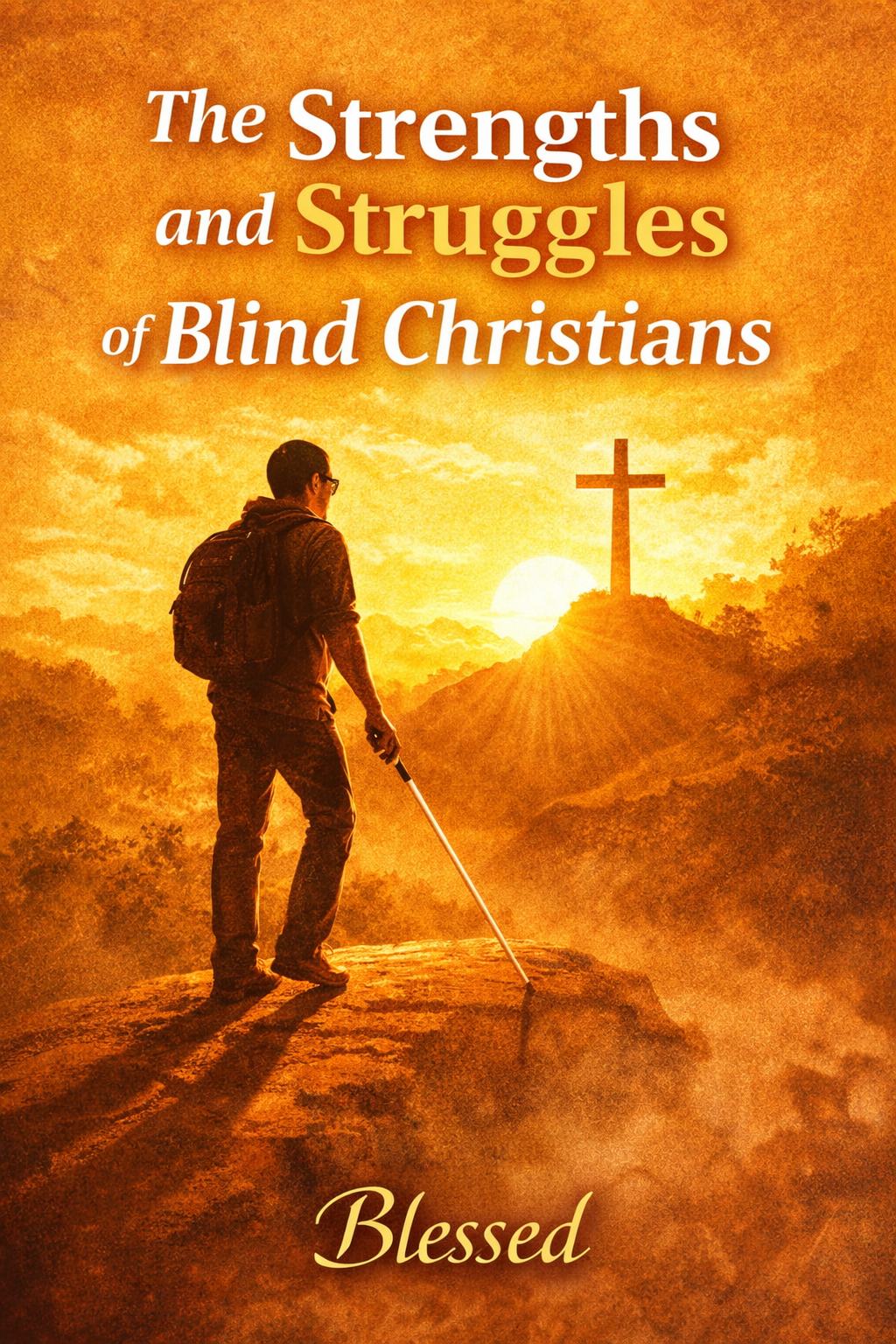
Introduction
There is a quiet strength that often grows in places the world misunderstands. When people think of blindness, they often think first of limitation. But within the Christian faith, blindness is not simply about what is absent — it is also about what is awakened.
Scripture reminds us that God does not measure people by outward ability. “The Lord sees not as man sees… the Lord looks at the heart” (1 Samuel 16:7). What the world may label as weakness, God often uses as a platform for His glory.
For many blind Christians, faith is not theoretical. It is lived, practiced, learned, and trusted daily. Their journey reveals both real struggles and remarkable strengths that can teach the wider church powerful lessons about resilience, dependence on God, and spiritual clarity.
This is not a story of pity. It is a story of perspective.
The Real Struggles Blind Christians Face
1. Physical and Environmental Barriers
Church spaces are not always designed with accessibility in mind. Printed bulletins, projected slides, small-font Bibles, and unannounced visual cues during services can create unnecessary obstacles.
Outside the church, navigating transportation, employment opportunities, and social systems often requires additional effort and advocacy.
Yet God’s heart has always been attentive to those with physical challenges. In the Old Testament law, He commanded His people, “You shall not put a stumbling block before the blind, but you shall fear your God” (Leviticus 19:14). Accessibility and consideration are not modern ideas — they reflect biblical compassion.
2. Social Misunderstanding
Many blind believers face assumptions:
- That they are helpless
- That they need constant assistance
- That their lives are defined by limitation
These stereotypes can feel more limiting than blindness itself.
But Jesus consistently challenged society’s assumptions. When His disciples asked about a man born blind — “Who sinned, this man or his parents?” — Jesus responded, “Neither… but that the works of God should be revealed in him” (John 9:1–3). Christ shifted the narrative from blame to purpose.
3. Emotional and Spiritual Questions
Blind Christians, like anyone facing adversity, may wrestle with honest questions:
- “Why did this happen?”
- “What is my purpose?”
- “Does God see me?”
Scripture never dismisses these struggles. The Psalms are filled with cries for understanding (Psalm 13:1–2). Yet they also affirm a powerful truth: “The Lord is near to the brokenhearted” (Psalm 34:18).
Struggle does not equal rejection. Questions do not cancel faith.
The Remarkable Strengths Blind Christians Develop
Where there is struggle, there is often growth.
1. Deepened Trust in God
When sight cannot be relied upon, trust becomes central. Many blind Christians describe a heightened awareness of God’s daily guidance.
This reflects the biblical principle: “For we walk by faith, not by sight” (2 Corinthians 5:7). What is a spiritual metaphor for many becomes a lived reality for some.
Faith becomes movement — even without visible certainty.
2. Heightened Spiritual Awareness
Without constant visual distraction, many blind believers cultivate strong listening skills and spiritual attentiveness. “So faith comes from hearing” (Romans 10:17). Worship, Scripture, and prayer often take on deeper dimensions through sound, meditation, and reflection.
Physical blindness does not prevent spiritual vision. In fact, Jesus often confronted those who could physically see but were spiritually blind (Matthew 15:14).
3. Resilience and Problem-Solving
Daily life requires adaptability. Navigating environments, technology, and systems builds resilience, creativity, and independence.
The Apostle Paul understood how weakness could produce strength. He wrote, “My grace is sufficient for you, for my power is made perfect in weakness” (2 Corinthians 12:9). What appears limiting can become the very space where God’s power is displayed.
4. A Powerful Testimony
Blind Christians often embody a living message: limitation does not cancel purpose.
The blind beggar Bartimaeus refused to be silenced when he cried out to Jesus (Mark 10:46–52). His persistence led to healing and transformation. Whether or not physical healing comes, the deeper miracle is always spiritual restoration and calling.
Value is not based on physical capacity but on identity in Christ (Galatians 3:26–28). Every believer carries divine worth.
What the Church Can Do Better
This topic is not only about inspiration; it is about responsibility.
Churches are called to be one body with many parts (1 Corinthians 12:12–27). When one member faces challenges, the entire body is called to respond with honor and support.
Practical steps include:
- Offering audio and braille resources
- Ensuring accessible seating and clear walkways
- Verbally describing visual elements in services
- Training leaders and volunteers in disability awareness
- Asking, not assuming, how to help
True community listens before it acts.
Lessons for Every Believer
Blind Christians teach the broader body of Christ powerful truths:
- We all walk by faith, not by sight (2 Corinthians 5:7).
- Weakness does not disqualify purpose (2 Corinthians 12:9).
- Dependence on God is strength, not failure (Proverbs 3:5–6).
- Identity is spiritual before it is physical (1 Samuel 16:7).
Sometimes those who cannot see physically help others see spiritually.
A Call to Perspective
Blindness is not the end of a story. It is part of a story. And within that story are courage, discipline, faith, and hope.
Instead of asking, “What can’t they do?” perhaps the better question is, “What can we learn?”
The strengths and struggles of blind Christians remind us that faith is not about perfect circumstances. It is about persistent trust.
And that kind of faith sees farther than eyes ever could.