
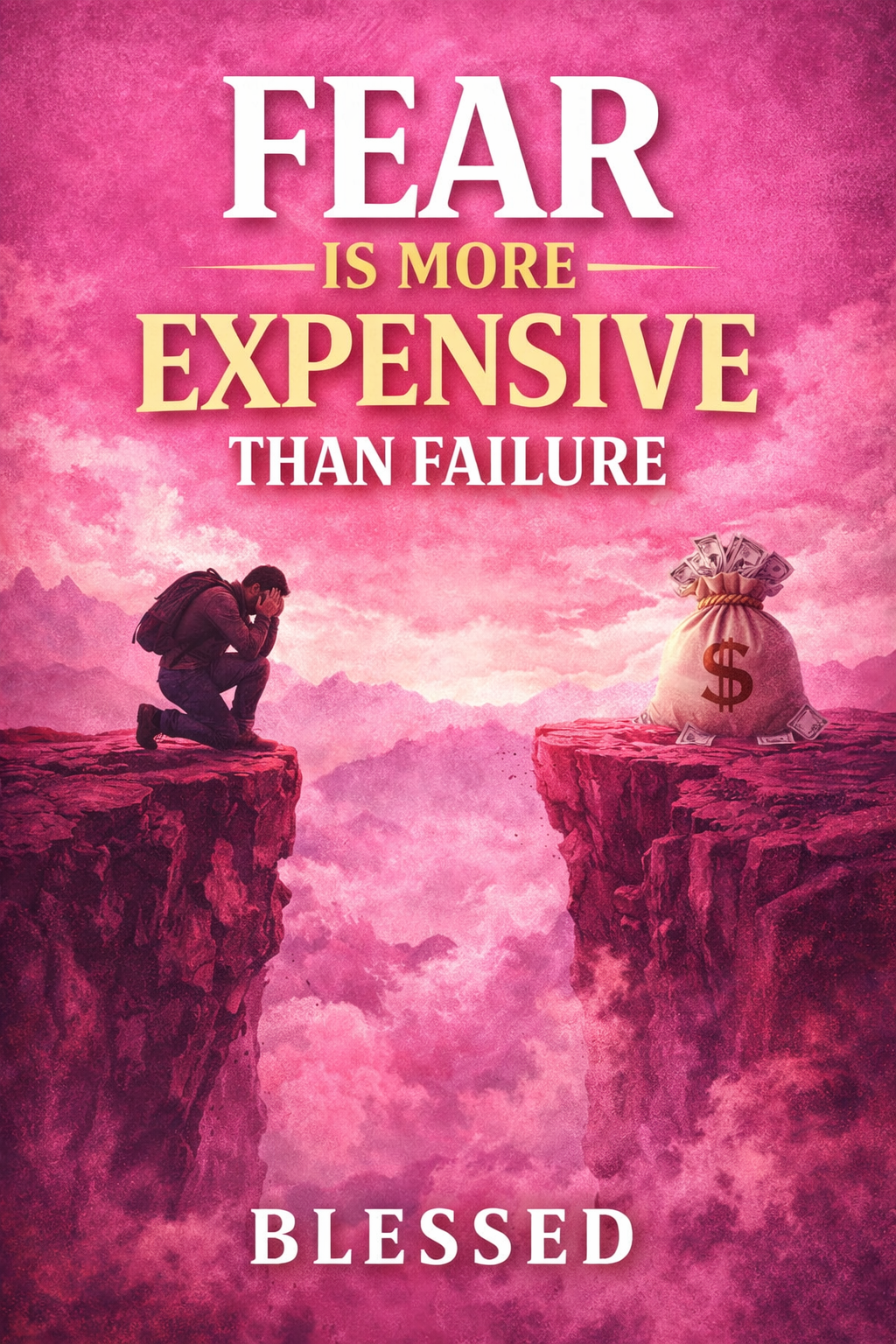
Fear costs more than failure ever will.
Most people avoid failure at all costs.
They avoid the conversation.
They avoid the opportunity.
They avoid the calling.
They avoid the step.
But what if the real loss is not failure?
What if the greater cost is fear?
Failure may bruise your ego.
Fear can bankrupt your destiny.
The Bible does not teach us to live fearfully — it teaches us to live faithfully. And there is a powerful difference.
The Hidden Cost of Fear
Fear rarely announces itself loudly. It disguises itself as:
- “I’m just being realistic.”
- “It’s not the right time.”
- “I need more preparation.”
- “What if it doesn’t work?”
While wisdom is necessary, fear often paralyzes.
In the Parable of the Talents (Matthew 25:14–30), the servant who buried his talent did not fail because he tried and lost. He failed because he was afraid to try.
He said, “I was afraid and went out and hid your talent in the ground.” (Matthew 25:25)
Fear didn’t protect him.
It cost him everything.
Failure Develops You — Fear Diminishes You
Failure teaches.
Fear traps.
Peter stepped out of the boat in Matthew 14:28–31. Yes, he sank. But he experienced something the other disciples never did — he walked on water.
The others stayed dry.
Peter grew.
Failure can refine your faith.
Fear prevents you from discovering what God can do through you.
God Did Not Design You to Be Governed by Fear
2 Timothy 1:7 says:
“For God has not given us a spirit of fear, but of power, love, and a sound mind.”
Fear does not come from your divine identity.
Power does.
Love does.
Clarity does.
When fear dominates your decisions, you operate beneath your spiritual authority.
The Israelites: A Lesson in the Price of Fear
In Numbers 13–14, twelve spies explored the Promised Land.
Ten returned with fear-driven reports:
- “We can’t do it.”
- “They are too strong.”
- “We looked like grasshoppers.”
Only Joshua and Caleb responded with faith.
The majority allowed fear to shape the narrative — and it cost an entire generation their inheritance.
They didn’t lose the promise because it wasn’t available.
They lost it because fear overruled faith.
Fear delayed destiny.
Actionable Steps to Break Fear’s Grip
If fear has been influencing your decisions, here are practical ways to reclaim movement:
1. Identify What Fear Is Costing You
Ask yourself honestly:
- What opportunity have I delayed?
- What calling have I ignored?
- What conversation have I avoided?
- What step have I postponed?
Write it down.
Clarity exposes fear’s price tag.
2. Replace “What If It Fails?” With “What If It Grows Me?”
Failure is rarely fatal.
But stagnation quietly erodes potential.
Romans 8:28 reminds us:
“And we know that in all things God works for the good of those who love him…”
Even missteps can be woven into purpose.
Nothing is wasted when surrendered to God.
3. Take One Faith-Based Action This Week
Not a reckless action — a faith-aligned one.
Examples:
- Submit the application.
- Launch the idea.
- Begin the study.
- Have the honest conversation.
- Serve where you feel called.
James 2:17 says:
“Faith by itself, if it is not accompanied by action, is dead.”
Faith requires movement.
4. Strengthen Courage Through Scripture
When fear rises, anchor yourself in truth:
- Isaiah 41:10 — “Do not fear, for I am with you…”
- Joshua 1:9 — “Be strong and courageous…”
- Psalm 56:3 — “When I am afraid, I put my trust in you.”
Fear shrinks when truth grows.
5. Redefine Failure Biblically
The Bible is filled with imperfect people who failed forward:
- Moses doubted.
- David stumbled.
- Peter denied.
- Paul persecuted.
Yet God still used them powerfully.
Failure did not disqualify them.
Fear would have.
The Compound Cost of Living Fearfully
Fear compounds over time.
Today, it costs you a step.
Tomorrow, it costs you confidence.
Later, it costs you impact.
Eventually, it can cost you purpose.
But courage compounds, too.
Every bold step strengthens your faith.
Every risk increases resilience.
Every act of obedience expands capacity.
Final Reflection
Failure may embarrass you temporarily.
Fear can imprison you permanently.
The cross itself looked like failure — but it became the doorway to victory. What appeared like defeat was actually divine fulfillment.
Do not let fear stop what faith is meant to start.
You may stumble.
You may adjust.
You may refine your approach.
But you will grow.
And growth is always worth more than comfort.
Fear is expensive.
Choose faith.
Frequently Asked Questions (FAQs)
1. Why is fear more expensive than failure in life?
Fear is more expensive than failure because it stops you from taking action, which leads to missed opportunities, delayed progress, and unrealized potential. While failure can teach and refine you, fear keeps you stagnant and prevents growth altogether.
2. How do I overcome fear of failure as a Christian?
You overcome fear of failure by grounding yourself in God’s Word, renewing your mind with scriptures like 2 Timothy 1:7 and Joshua 1:9, and taking small steps of faith. Trusting God’s plan helps you move forward even when outcomes are uncertain.
3. What does the Bible say about fear and destiny?
The Bible teaches that fear is not from God, but a spirit that hinders purpose (2 Timothy 1:7). Scripture consistently encourages believers to walk in faith, courage, and obedience so they can fulfill their divine calling without limitation.
4. Can fear really stop someone from fulfilling their purpose?
Yes. Fear can delay or completely block destiny by preventing people from acting on opportunities God has placed before them. Biblical examples like the Israelites in Numbers 13–14 show how fear can cost generations their inheritance.
5. What are practical steps to stop living in fear?
Practical steps include identifying what fear is costing you, replacing fearful thoughts with faith-based thinking, taking intentional action, meditating on scripture, and redefining failure as part of growth rather than defeat.
Action Step
Pick the thing you’ve been avoiding because it makes you uncomfortable—and do the smallest possible version of it within 24 hours. Not when you feel ready. Not when fear disappears. Just one bold, intentional move that breaks the pattern, even if your hands are shaking.