
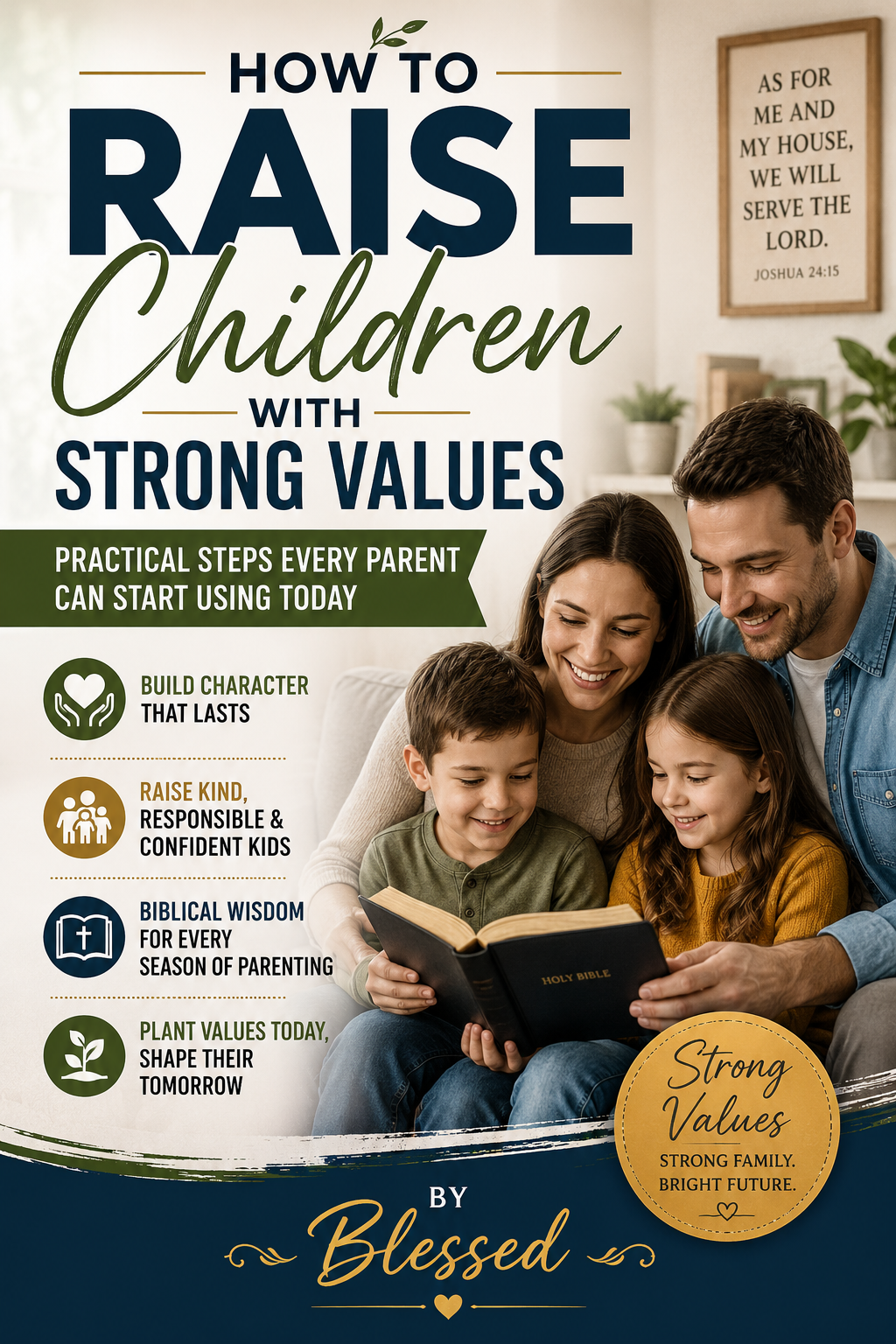
“Train up a child in the way he should go; even when he is old he will not depart from it.” — Proverbs 22:6
Introduction: The Greatest Thing You Will Ever Build
No house you build will outlast your children.
No career achievement will carry your name further than the character of the people you raise.
The values you plant in your children today can impact generations tomorrow.
Parenting is one of the most important responsibilities on earth — yet many people underestimate its influence.
Today’s world is louder, more confusing, and more morally divided than ever before. Children are constantly surrounded by competing voices through social media, entertainment, peer pressure, and culture.
That is why children need more than rules.
They need:
- Strong values
- Clear identity
- Godly direction
- Wise guidance
- Consistent love
The good news is this:
You do not need to be a perfect parent to raise children with strong values.
You simply need to be:
- Present
- Intentional
- Consistent
- Spiritually grounded
This article shares 10 practical biblical principles every parent can begin applying today to help raise children with integrity, wisdom, compassion, and strong character.
1. Model the Values You Want Your Children to Learn
Children learn more from what they see than from what they hear.
Your life is your child’s first lesson.
If you want your child to:
- Tell the truth
- Show kindness
- Respect others
- Live responsibly
- Walk with God
…they must first see those values in you.
Children watch:
- How do you speak when angry
- How you treat people
- How you handle stress
- How you respond to disappointment
- Whether your actions match your words
A parent who lives honestly teaches honesty naturally.
A parent who apologises when wrong teaches humility powerfully.
Biblical Foundation
In Deuteronomy 6:6–7, God instructed parents to teach His commands continually during everyday life — while sitting at home, walking along the road, lying down, and rising up.
This shows that values are taught most effectively through daily living.
Your home is your child’s first classroom.
Make sure your lifestyle reflects the lessons you want them to carry for life.
2. Explain the “Why” Behind Every Value
Children naturally ask questions.
That is not rebellion — it is growth.
When parents only give rules without explanation, children may obey temporarily. But when children understand why a value matters, they develop conviction.
And conviction lasts longer than supervision.
Instead of saying:
- “Respect people.”
Explain:
- Respect builds healthy relationships.
- Respect earns trust.
- Respect reflects God’s love.
Instead of saying:
- “Always tell the truth.”
Explain:
- Honesty protects your reputation.
- Integrity opens doors.
- Lies destroy trust.
When children understand the purpose behind values, they begin to own those values personally.
That inner conviction helps them resist:
- Peer pressure
- Negative influences
- Social media pressure
- Bad friendships
3. Set Clear Boundaries and Stay Consistent
Consistency is one of the strongest expressions of love.
Children thrive in environments where expectations are clear and stable.
When rules constantly change based on moods or emotions, children become confused.
Clear boundaries help children feel:
- Safe
- Secure
- Guided
- Protected
What Consistency Looks Like
- Keeping your word
- Following through calmly
- Applying consequences fairly
- Avoiding empty threats
Children do not need perfection.
They need predictability.
And when you make mistakes as a parent, apologise sincerely.
A parent who admits mistakes teaches responsibility and humility.
4. Create a Home Where Communication Feels Safe
A child who feels safe talking to you will continue coming to you.
A child who fears judgment may begin to hide their struggles.
Your goal is not simply to control behaviour.
Your goal is to build trust.
Create a home where your child feels comfortable discussing:
- Mistakes
- Questions
- Fears
- Temptations
- Failures
- Confusion
Listen calmly before reacting emotionally.
Helpful Questions to Ask
- “What was the hardest part of your day?”
- “How did that situation make you feel?”
- “What do you think would have been the right choice?”
- “How can I help you?”
These conversations help children develop emotional maturity and wisdom.
Most importantly, they remind your child:
“Home is a safe place.”
5. Give Them Responsibility Early
Responsibility builds character.
Children should learn from an early age that they have meaningful roles to play.
Give them age-appropriate responsibilities such as:
- Cleaning their room
- Helping with chores
- Caring for younger siblings
- Completing schoolwork responsibly
- Assisting with simple household tasks
Responsibility teaches:
- Discipline
- Accountability
- Work ethic
- Independence
- Confidence
Children who grow up carrying responsibility often become adults who can manage life wisely without constant supervision.
Small daily responsibilities build stronger character than occasional rewards.
‘Responsibility is about more than completing chores or helping around the house. It also includes learning how to manage resources wisely. One of the most important ways children can develop responsibility is by learning how to handle money. Teaching them to save, give, and spend wisely equips them with valuable life skills that will serve them well into adulthood. However, teaching children biblical money values is so important while raising financially wise children
6. Teach Empathy Through Real-Life Experiences
Empathy grows through experience.
Children learn compassion when they see compassion practiced.
Allow your child to witness acts of kindness and generosity.
Examples include:
- Visiting sick neighbours
- Helping struggling families
- Supporting grieving people
- Giving to those in need
- Serving in the church or community outreach
Biblical Example: The Widow of Zarephath
In 1 Kings 17, the widow of Zarephath gave Elijah the last of her food during a famine.
Her son witnessed her generosity during hardship.
That act of faith was followed by miraculous provision from God.
Children remember what their parents do during difficult seasons.
Your generosity during hard times can shape your child’s heart for life.
7. Introduce Them to Positive Role Models
The people children admire strongly influence the people they become.
If parents do not intentionally provide healthy role models, culture and social media will fill the gap.
Surround your children with people of strong character:
- Wise family members
- Godly mentors
- Caring teachers
- Faithful church leaders
- Responsible adults
Also, introduce them to inspiring stories from Scripture and history.
Biblical Example: Joseph
Joseph’s life in Genesis 39–41 teaches integrity under pressure.
He was:
- Betrayed
- Sold into slavery
- Falsely accused
- Imprisoned unjustly
Yet Joseph remained faithful and honourable in every season.
His circumstances changed many times, but his character remained strong.
Teach your children that true character is revealed during difficult moments.
8. Praise Character More Than Performance
Modern culture often celebrates achievement more than character.
But wise parenting focuses on who the child is becoming — not only what the child accomplishes.
When your child succeeds, praise the values behind the success:
- Hard work
- Discipline
- Honesty
- Patience
- Kindness
- Persistence
For example:
- Praise honesty when they admit wrongdoing.
- Praise compassion when they help someone quietly.
- Praise effort, not only results.
Children gradually become what they are consistently encouraged to value.
When a character becomes part of identity, children begin making wise choices even when no one is watching.
9. Turn Mistakes Into Teaching Moments
Every child will make mistakes.
They will fail, struggle, disobey, and sometimes disappoint you.
That does not mean your parenting has failed.
It means your child is human.
The important question is:
How will you respond?
A child who is only punished may learn fear.
But a child who is guided through mistakes learns wisdom.
Instead of reacting only with anger:
- Discuss what happened
- Ask what they learned
- Talk about better choices
- Help them make things right
Teach restoration, not only punishment.
The goal is not to raise a child who never fails.
The goal is to raise a child who learns how to respond wisely after failure.
10. Ground Their Values in God
Rules alone cannot sustain character forever.
Children need values rooted in something deeper than fear of punishment.
They need spiritual foundations.
Teach your children:
- Why integrity matters
- Why kindness matters
- Why forgiveness matters
- Why humility matters
- Why people matter to God
Help them understand that godly values are not merely “good behaviour.”
They are the foundation of a meaningful life.
Proverbs 4:23
“Above all else, guard your heart, for everything you do flows from it.”
Teach your children to guard:
- Their hearts
- Their minds
- Their friendships
- Their influences
- Their thoughts
Because what grows internally eventually shapes their entire lives.
Conclusion: Consistency Matters More Than Perfection
No parent gets everything right.
There will be days when:
- You lose patience
- You react emotionally
- You miss opportunities
- You feel exhausted
That is part of being human.
But every day you continue showing up with love, wisdom, consistency, and intentionality, you are building something powerful.
You are not simply raising a well-behaved child.
You are shaping:
- Future leaders
- Future parents
- Future husbands and wives
- Future servants of God
- Future generations
Your home is the first school.
You are the first teacher.
And the seeds you plant today may continue growing long after you are gone.
“Her children arise and call her blessed; her husband also, and he praises her.” — Proverbs 31:28
A Declaration for Every Parent
“I will not parent for perfection — I will parent with presence. I will model what I ask for, speak what I believe, and love consistently enough that my child always knows where home is. The values I plant today are the harvest future generations will eat. Lord, help me build well.”