
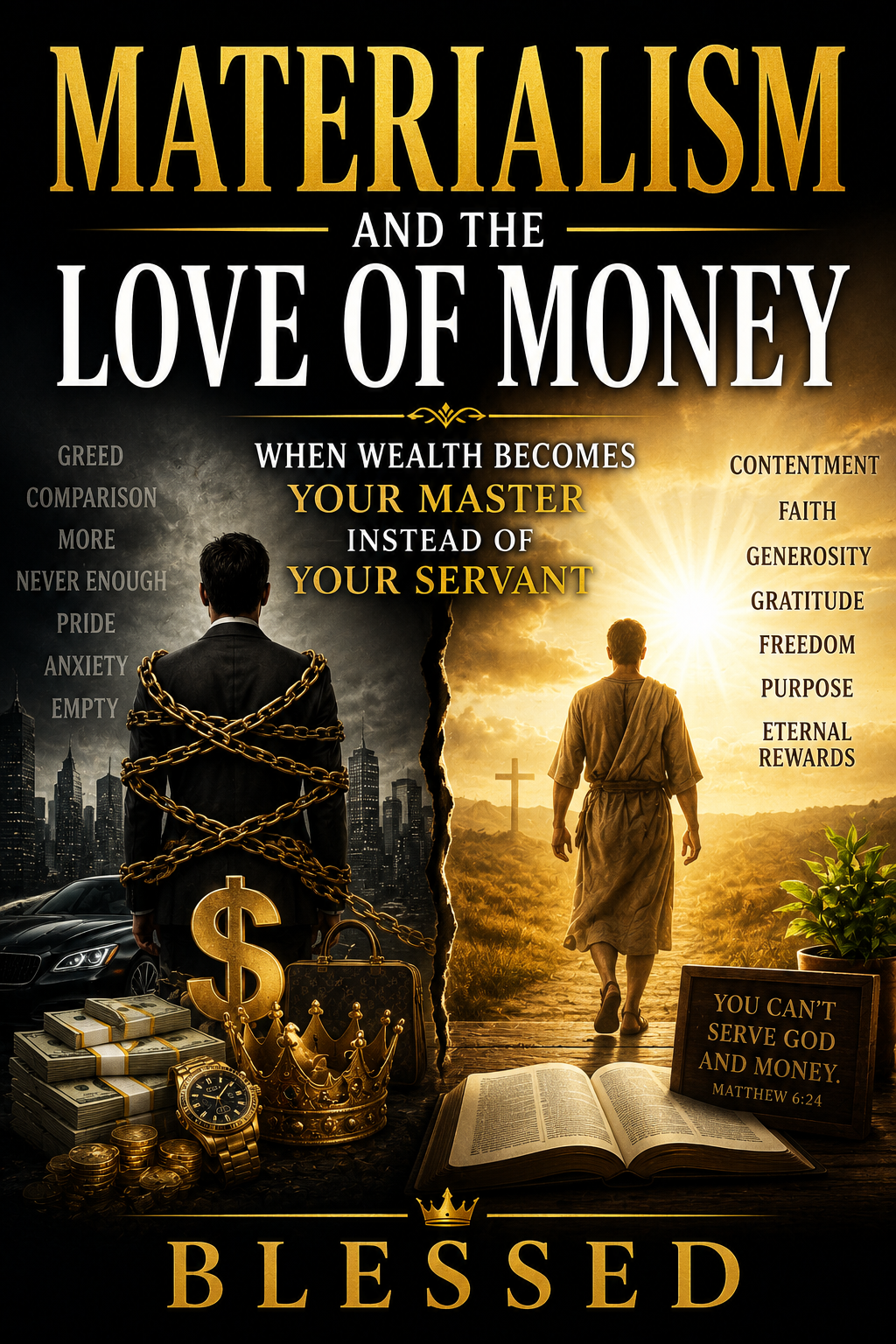
INTRODUCTION
There is a quiet moment that many Christians eventually face.
You look at your bank account, your possessions, your career trajectory — and you ask yourself an uncomfortable question: Do I own these things, or do they own me?
It rarely happens all at once. Materialism doesn’t usually announce itself. It creeps in through small compromises — a little more comparison, a little more anxiety about “not having enough,” a little more time spent chasing things than chasing God.
Money itself is not evil. It is a tool, a resource, even a blessing. But when wealth shifts from being something you use to something you serve, it stops being a gift and becomes a god.
This article will walk you through what materialism really is, why the Bible warns so strongly against the love of money, and — most importantly — how to guard your heart so that wealth remains your servant, never your master.
1. What Is Materialism?
Materialism is the practice of finding your identity, security, or happiness in possessions, money, or status rather than in God’s purposes for your life.
It is not simply owning things. It is living for things. A materialistic heart measures its worth by what it has accumulated, not by who it is in Christ.
Jesus addressed this directly:
“Do not store up for yourselves treasures on earth, where moths and vermin destroy, and where thieves break in and steal. But store up for yourselves treasures in heaven… For where your treasure is, there your heart will be also.” (Matthew 6:19–21)
He also warned the crowd plainly:
“Watch out! Be on guard against all kinds of greed. Life does not consist of an abundance of possessions.” (Luke 12:15)
Modern materialism looks different from what it did two thousand years ago, but the heart condition is identical. Today, it shows up as the pressure to upgrade your phone every year, the comparison trap of social media highlight reels, and the belief that the next promotion or purchase will finally bring peace.
It is the same root, dressed in new clothing.
2. Is Money Itself Evil?
No. This is one of the most misunderstood verses in Scripture. People often misquote 1 Timothy 6:10 as saying “money is the root of all evil.” That is not what it says.
Paul actually wrote:
“For the love of money is a root of all kinds of evil.” (1 Timothy 6:10)
The problem was never the currency in your wallet. The problem is the posture of the heart toward it.
Money can build hospitals, fund missionaries, feed orphans, and bless families. In the hands of a generous, Christ-centered believer, wealth becomes a powerful instrument for good. But in the grip of a greedy or anxious heart, that same wealth becomes a chain.
Wealth was designed to be a tool in your hand — not a throne in your heart.
3. Eight Warning Signs That Money Has Become an Idol
Idolatry doesn’t always look like a golden statue. Sometimes it looks like a spreadsheet. Examine your heart honestly against these signs.
- You constantly think about getting richer, even during prayer or worship.
- You neglect God’s presence and His house because you are “too busy” building wealth.
- You compromise your honesty for financial gain.
- You refuse to give or help others in genuine need.
- You measure your success — and other people’s worth — by possessions alone.
- You feel resentment or envy toward those who have more than you.
- You feel more secure looking at your account balance than you do trusting God’s promises.
- You experience anxiety, not peace, when you think about your finances.
If even one of these resonates uncomfortably, take it as an invitation — not a condemnation. Conviction is not the same as condemnation; it is God’s gentle invitation to come back to Him.
4. What Causes Materialism to Take Root?
Materialism rarely grows from nowhere. It is usually fed by deeper soil conditions, including:
- Fear of poverty — a belief that God will not provide, so you must hoard to feel safe.
- Comparison — measuring your life against curated images of other people’s wealth.
- Pride — wanting possessions as proof of personal significance.
- Greed — an insatiable appetite for “more,” no matter how much you already have.
- Advertising and consumer culture — a relentless message that you are incomplete without the next purchase.
- Lack of contentment — an unsettled heart that cannot rest in what God has already given.
Naming the root cause matters. You cannot uproot a weed you refuse to identify.
5. Biblical Examples: When Love of Money Led to Ruin
Scripture does not merely warn us about materialism in the abstract — it shows us real people whose stories serve as sobering mirrors.
Judas Iscariot walked daily with Jesus, witnessed His miracles, and heard His teaching firsthand — yet thirty pieces of silver were enough to make him betray the Son of God (Matthew 26:14–15). Proximity to Jesus does not automatically protect a heart that loves money more than it loves Him.
The Rich Young Ruler approached Jesus sincerely, asking how to inherit eternal life. He had kept the commandments faithfully. But when Jesus told him to sell his possessions and follow Him, he went away sad, because he had great wealth (Matthew 19:21–22). He walked away from eternal life because he could not let go of temporary riches.
Ananias and Sapphira allowed greed to push them into deception, lying to the Holy Spirit about money they had withheld — a choice that cost them their lives (Acts 5:1–10). Their story is a stark reminder that the love of money can corrupt integrity even within the church.
Solomon, the wealthiest king in Israel’s history, eventually concluded that whoever loves money never has enough, calling it meaningless (Ecclesiastes 5:10). If anyone had the resources to test whether riches satisfy the soul, it was Solomon — and his verdict still stands as a warning today.
6. The Spiritual Dangers of Loving Money
When wealth is enthroned in the heart, it produces fruit that slowly poisons a believer’s life:
- Greed that is never satisfied
- Pride that despises others
- Dishonesty that compromises integrity
- Anxiety that steals peace
- Broken relationships fractured by jealousy or selfishness
- Spiritual compromise that slowly pulls a person away from God’s kingdom priorities
Materialism doesn’t just empty your wallet of generosity — it empties your soul of peace.
7. What Does the Bible Actually Teach About Wealth?
Scripture maintains a careful balance. God is not against prosperity, but He is fiercely protective of your heart’s loyalty.
The Bible encourages:
- Honest work as the dignified path to provision (2 Thessalonians 3:10).
- Wise saving and planning (Proverbs 21:20).
- Radical generosity (2 Corinthians 9:6–8).
- Contentment in every circumstance (Hebrews 13:5).
- Faithful stewardship, recognizing that everything ultimately belongs to God (Proverbs 3:9–10).
Wealth, biblically understood, is a stewardship — not a personal trophy.
8. How to Guard Your Heart Against Materialism: Action Steps
Knowing the danger is not enough. Here is how to actively protect your heart.
- Put God first — before your budget, before your business, before your bank balance.
- Practice generosity — give intentionally and regularly, even when it stretches you.
- Live within your means — resist the lifestyle inflation that debt and comparison demand.
- Avoid unnecessary comparison — mute the voices, online or offline, that fuel envy.
- Cultivate gratitude daily — name specific blessings you already have.
- Give to those in need — let compassion move you to action, not just sympathy.
- Remember eternity — let the shortness of life reframe your long-term priorities.
- Pray for contentment — ask God directly to settle and satisfy your heart.
These are not one-time decisions. They are daily disciplines that, practiced consistently, retrain a materialistic heart toward Christ.
9. Contentment: The Antidote to Materialism
Contentment is not the same as laziness or low ambition. A Christian can pursue excellence, build a career, and grow financially — all while remaining deeply content in Christ.
Paul modeled this powerfully:
“I have learned the secret of being content in any and every situation, whether well fed or hungry, whether living in plenty or in want. I can do all this through him who gives me strength.” (Philippians 4:11–13)
Notice that contentment was something Paul learned — it did not come naturally, even to an apostle.
True satisfaction is not the absence of want; it is the presence of Christ.
10. Using Wealth for God’s Glory
When money is rightly ordered under God’s lordship, it becomes a remarkable tool for kingdom impact. Believers can use their resources to:
- Support the work of the local church
- Care for the poor and vulnerable
- Responsible help family members in need
- Encourage and fund missionaries
- Bless their communities
- Meet genuine needs around them
Money makes an excellent servant but a terrible master. The same resource that can enslave a greedy heart can liberate a generous one.
Frequently Asked Questions
1. Is it wrong for Christians to be rich? No. The Bible does not condemn wealth itself. It warns against trusting in riches or making them more important than God.
2. What does the Bible mean by “the love of money”? It refers to an unhealthy devotion to money that controls a person’s decisions, priorities, and heart above God.
3. How can I know if I am becoming materialistic? Ask yourself honestly whether possessions, status, or financial success have become more important to you than your relationship with God, your integrity, or your willingness to help others.
4. Can Christians pursue financial success? Yes. Honest work, wise planning, and financial growth are encouraged in Scripture, provided they are pursued with integrity and used to honor God.
5. How can I overcome the love of money? Grow in contentment, practice consistent generosity, trust God as your true provider, and regularly remind yourself that eternal treasures outweigh every earthly possession.
Conclusion
Money is one of God’s good gifts, but it was never meant to become our god. Possessions can provide comfort and meet legitimate needs, but they cannot satisfy the deepest longings of the human soul. Lasting peace, security, and purpose are found only in a relationship with God.
The challenge before every believer is not simply to avoid loving money, but to love God more. When Christ sits on the throne of your heart, wealth finally takes its rightful place — as a tool for serving others, advancing His kingdom, and glorifying His name, rather than a master that quietly controls you.
Heavenly Father,
Thank You for providing for my needs and for every good gift You have given me. Guard my heart against greed, materialism, and the love of money. Help me to trust You more than my possessions and to find my true security in You alone.
Teach me to be content in every season, generous toward others, and faithful in managing the resources You have entrusted to me. May my life reflect that You are my greatest treasure, and may everything I own be used to bring glory to Your name.
In Jesus’ name, Amen.
Has this message challenged you to examine your relationship with money? Share this article with someone who needs to hear it today, and leave a comment below — what step will you take first to guard your heart against materialism?