
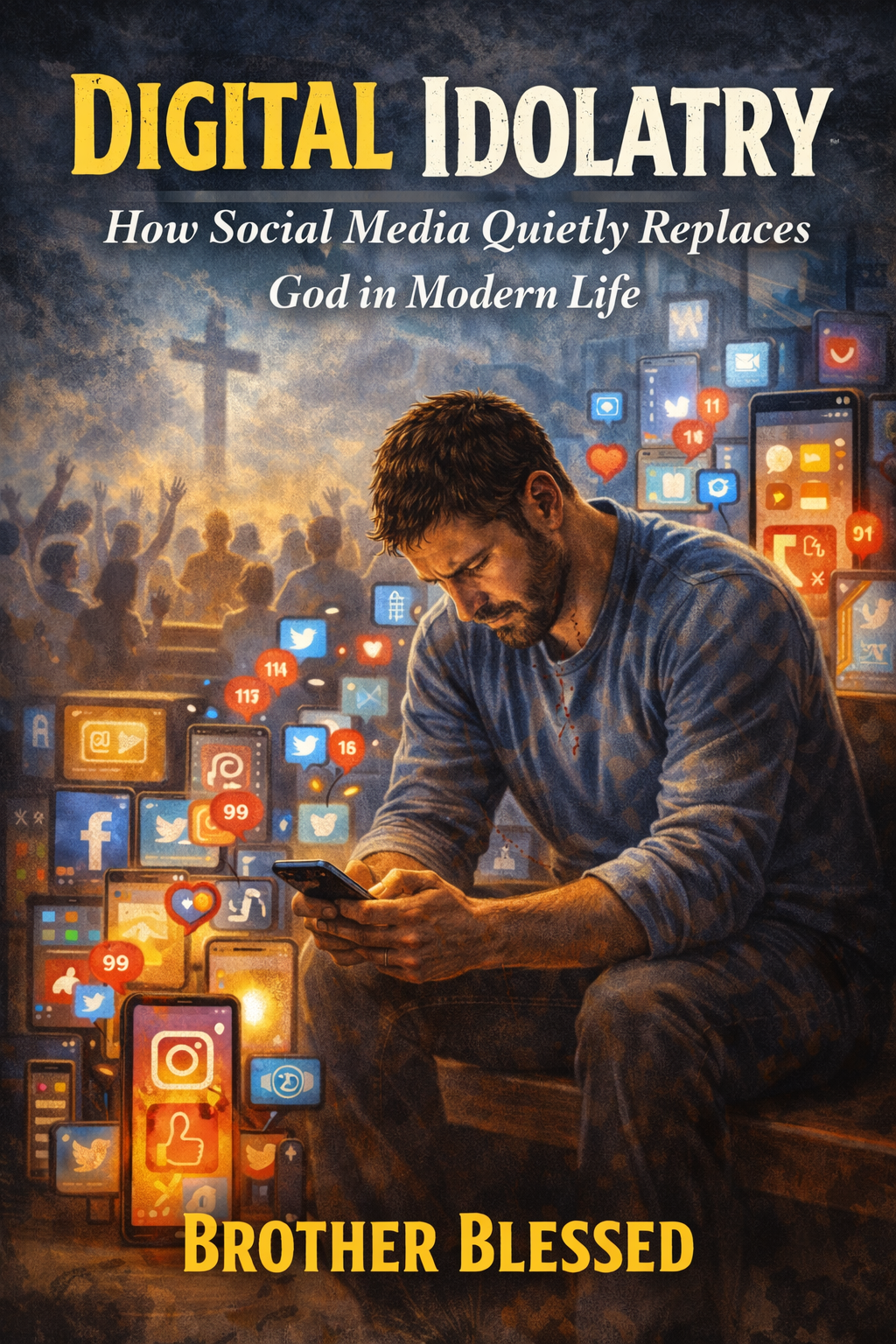
It Doesn’t Feel Like Worship. That’s the Problem.
You didn’t bow to it.
You didn’t build a shrine.
You never consciously decided to place it above God.
But somewhere between your morning alarm and midnight, your thumb reached for your phone again — and again — and again.
Meanwhile, your Bible stayed closed.
That is not meant to condemn you. It is meant to reveal something many believers quietly struggle with.
Modern idolatry rarely looks ancient.
It looks ordinary.
It looks like endless scrolling.
Constant notifications.
Emotional dependence on online validation.
A mind that cannot stay still long enough to pray.
We live in a generation where distraction has been carefully engineered to keep our attention captive. Social media platforms are designed to reward repeated engagement, trigger emotional responses, and make silence feel uncomfortable.
And over time, something subtle happens:
Prayer starts feeling difficult.
Worship feels distant.
Silence feels unbearable.
God’s voice feels quieter than the world around us.
Not because God moved away — but because our attention moved elsewhere.
What Idolatry Really Looks Like Today
Many people imagine idolatry as statues, temples, or carved images.
But idolatry has always been deeper than that.
At its core, idolatry is anything that slowly takes the place that belongs to God in your heart.
It is whatever captures:
- your attention,
- your dependence,
- your emotional security,
- your identity,
- and your devotion.
Jesus said:
“Where your treasure is, there your heart will be also.” — Matthew 6:21
Your treasure is revealed by what you instinctively return to.
What do you reach for when you feel lonely?
Anxious?
Bored?
Emotionally tired?
For many people today, the answer is not prayer.
It is a screen.
Not because they hate God.
Not because they intentionally rejected Him.
But because phones are immediate, stimulating, and always available, while intimacy with God requires stillness, patience, and attention.
And stillness has become difficult for modern minds.
The Quiet Ways Social Media Replaces God
Idolatry rarely arrives dramatically.
It develops slowly through repeated habits.
Here are some of the ways social media quietly displaces God without many believers noticing.
1. It Steals Time That Belongs to God
Many people spend hours every day online while struggling to spend even fifteen focused minutes with God.
The danger is not one long scrolling session.
The danger is the accumulated effect of small distractions repeated daily.
You open your phone for one notification, and thirty minutes later, you cannot even remember what you intended to check.
Sometimes, you tell yourself you are only replying to messages or checking one update. Then suddenly, an hour disappears.
You move from one app to another.
One video to the next.
One conversation after another.
Before you realize it, the time is gone.
Some people have even looked up and realized it was already Sunday morning, and they were rushing to church after spending most of the night buried in their phones.
That is how digital distraction works.
Not loudly.
Not suddenly.
But slowly, quietly, and repeatedly.
Five minutes here.
Ten minutes there.
A quick check that becomes an hour.
Over time, spiritual hunger weakens because the soul is constantly consuming noise.
2. It Replaces God’s Approval With Human Validation
Likes.
Comments.
Views.
Followers.
These things can quietly become emotional measurements of worth.
A successful post lifts your mood.
Low engagement discourages you.
Without realizing it, identity slowly shifts from being rooted in Christ to being rooted in public response.
Instead of living before God, many people begin performing for invisible audiences online.
And performance is exhausting.
3. It Feeds Constant Comparison
Social media presents edited versions of people’s lives.
Their victories.
Their beauty.
Their relationships.
Their achievements.
Their struggles.
Constant exposure to curated lives creates dissatisfaction with your own.
Comparison quietly produces:
- envy,
- insecurity,
- anxiety,
- impatience,
- and resentment.
It becomes difficult to thank God for your journey when you are endlessly measuring it against somebody else’s highlight reel.
4. It Destroys Deep Focus
Notifications train the brain to expect interruption.
As a result, many people now struggle to focus deeply during:
- prayer,
- Bible study,
- worship,
- conversations,
- or even quiet reflection.
The mind becomes conditioned for stimulation instead of stillness.
Yet throughout Scripture, God often speaks in quietness, reflection, and attentive listening.
A distracted soul struggles to hear clearly.
5. It Creates the Illusion of Connection While Deepening Spiritual Loneliness
You can spend all day interacting online and still feel spiritually empty.
Digital interaction is not the same as genuine fellowship.
You can receive messages, reactions, and comments while still lacking:
- real accountability,
- authentic relationships,
- spiritual encouragement,
- and intimacy with God.
Many people are socially connected but spiritually isolated.
And that isolation often hides beneath constant online activity.
Be Honest: Are These Signs Already Showing Up?
Take a moment and reflect honestly.
- Your phone is the first thing you touch in the morning.
- You feel anxious when you have not checked your phone for a while.
- Social media affects your mood more than prayer does.
- Scrolling feels easier than reading Scripture.
- You have gone days without intentional prayer but not without social media.
- Silence feels uncomfortable without digital stimulation.
- You compare yourself to people online and feel inadequate afterward.
If several of those describe your life consistently, this is probably not just a time-management issue.
It is a spiritual formation issue.
Because whatever consistently shapes your thoughts eventually shapes your heart.
What Scripture Says About Your Attention
The Bible repeatedly emphasizes the importance of the mind and attention.
“Set your minds on things above, not on earthly things.” — Colossians 3:2
And:
“Do not conform to the pattern of this world, but be transformed by the renewing of your mind.” — Romans 12:2
Your mind is constantly being formed by whatever you repeatedly consume.
Every hour spent absorbing outrage, comparison, entertainment, and distraction shapes your thinking.
But every hour spent in:
- prayer,
- worship,
- Scripture,
- silence,
- and fellowship
shapes your soul differently.
Formation is happening either way.
Pause for a moment and ask yourself honestly:
What has your attention been feeding more lately — your spirit or your distraction?
Because whatever consistently receives your attention will eventually influence your desires, your thoughts, and your relationship with God.
The question is: who — or what — is shaping you most?
How to Reclaim Your Heart From Digital Distraction
Freedom does not begin with guilt.
It begins with awareness and intentional change.
Here are practical ways to put God back at the center of your attention.
1. Let God Be the First Voice You Hear Each Morning
Before opening social media, spend a few minutes with God.
Read a Psalm.
Pray honestly.
Sit quietly for a moment.
Starting the day with God changes the direction of your attention before the noise begins.
2. Create Phone-Free Sacred Spaces
Protect certain moments from digital interruption.
Examples include:
- your devotional time,
- meals,
- church services,
- conversations,
- and the hour before sleep.
Not every moment should be shared with a screen.
3. Audit What You Consume
Some content weakens your spiritual life even if it does not look sinful.
Pay attention to what consistently produces:
- envy,
- lust,
- fear,
- insecurity,
- anger,
- or spiritual dullness.
You do not need to keep consuming content that damages your soul.
Be intentional about what shapes your mind.
4. Replace the Habit Instead of Only Removing It
Simply trying to “use your phone less” often fails.
Habits are easier to change when replaced with healthier alternatives.
When you feel the urge to scroll mindlessly, try:
- listening to worship music,
- reading a verse,
- journaling,
- praying briefly,
- or sitting quietly before God.
Small replacements slowly reshape daily patterns.
5. Practice Regular Digital Fasting
Take intentional breaks from social media.
Maybe:
- one hour daily,
- one evening weekly,
- or one full day monthly.
The goal is not punishment.
The goal is to create space to hear God clearly again.
Many people do not realize how mentally noisy they have become until they step away from constant stimulation.
6. Reconnect With Real Community
Online interaction should never replace real spiritual fellowship.
Spend time physically present with believers who can:
- encourage you,
- pray with you,
- challenge you,
- and genuinely know you.
Healthy spiritual growth rarely happens in isolation.
7. Anchor Your Identity Before Opening the App
Before engaging online, remind yourself:
You are loved by God.
Chosen by God.
Known by God.
Valuable because of Christ — not because of attention, popularity, or visibility.
When identity is rooted in God, social media loses much of its power to control emotions.
Technology Is Not Evil — But It Must Never Become Your Master
Phones are tools.
Social media is a tool.
Technology itself is not the enemy.
These platforms can spread truth, encourage people, strengthen families, and share the gospel.
But good tools become dangerous when they take the place only God should occupy.
Every idol promises fulfillment while slowly draining the soul.
That is why God warned:
“You shall have no other gods before me.” — Exodus 20:3
That command still matters in the smartphone era.
Because idols change form, but the human heart remains vulnerable to worshipping created things instead of the Creator.
The Battle for Your Attention Is Spiritual
Every day, something competes for your focus.
The world fights loudly for your attention through noise, urgency, entertainment, and endless scrolling.
God does not compete that way.
His invitation is quieter.
Steadier.
Deeper.
He offers what distraction never can:
- peace,
- presence,
- clarity,
- rest,
- and genuine communion.
The screen will always demand more.
God simply waits to be chosen.
So put the phone down for a moment.
Not out of guilt.
Not out of fear.
But long enough to remember what life feels like when God becomes the loudest voice in your heart again.
You were not created merely to consume content.
You were created for fellowship with God.
And He is still waiting.
A Short Prayer
Lord, help me recognize the distractions that quietly pull my heart away from You.
Teach me to desire Your presence more than constant noise and endless scrolling.
Renew my mind, restore my focus, and help me place You back at the center of my daily life.
May my attention, my time, and my worship belong first to You.
Amen.