
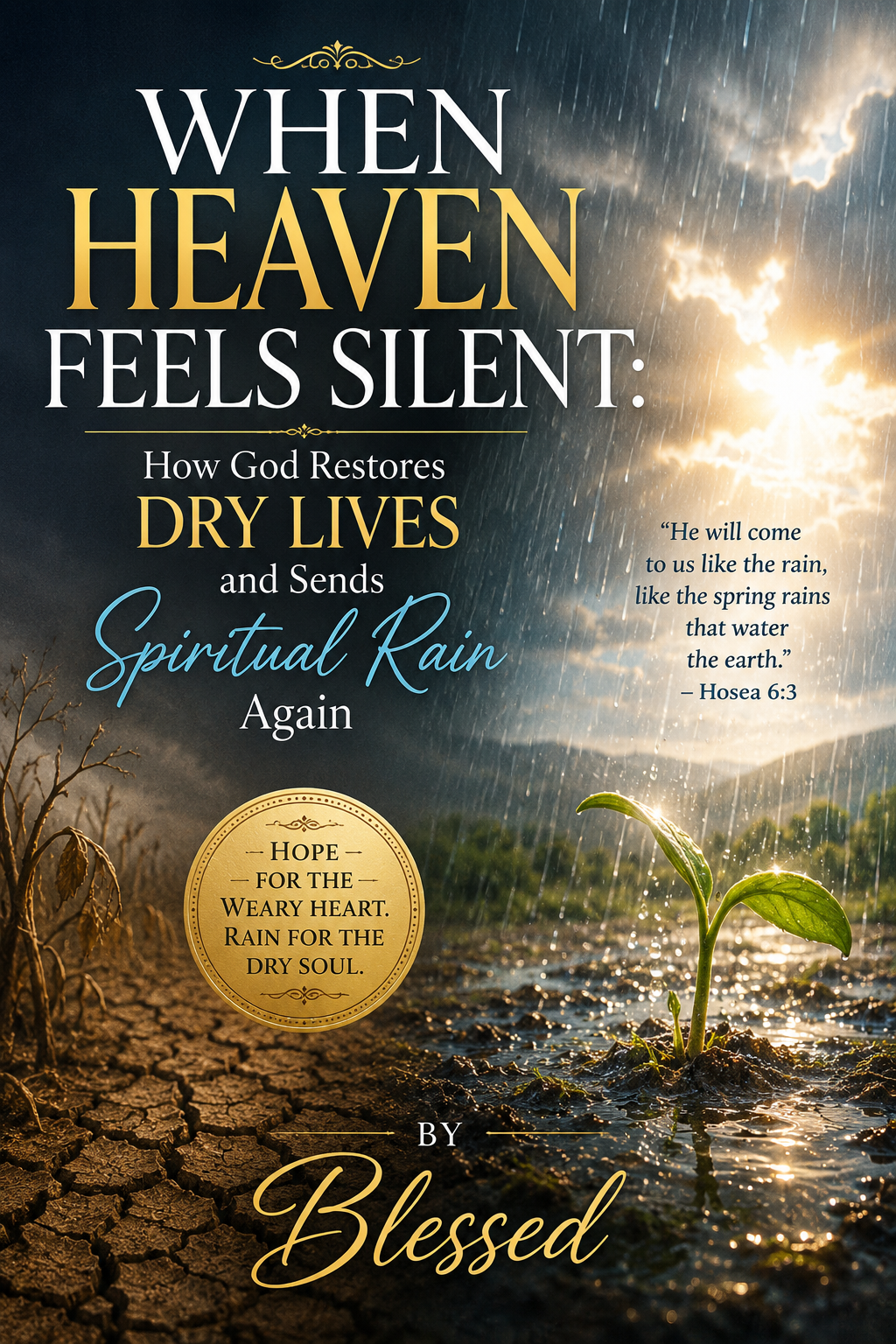
“He will come to us like the rain, like the spring rains that water the earth.” — Hosea 6:3
Introduction: The Weight of a Dry Season
There is a particular kind of exhaustion that only people who have been waiting on God truly understand.
It is not physical tiredness. It is deeper — the weariness of someone who has prayed faithfully, believed sincerely, served consistently, and still finds themselves standing in the same dry place, wondering why the rain has not come.
You pray, but the ceiling feels like concrete. You open your Bible, but the words feel flat. You watch others move forward while you remain still — and you whisper the question that almost every sincere believer has asked at some point:
“God, are You still there?”
If that is where you are today, this article was written for you. Because the silence you are hearing is not God’s absence. And the dry ground beneath your feet is not your final address. Throughout Scripture, every person who cried out to God from a place of genuine spiritual dryness eventually received rain.
Not always when they expected it. But the rain always came.
What Spiritual Rain Really Means
Before we talk about how to end a dry season, we need to understand what we are actually asking for when we pray for spiritual rain.
In the natural world, rain is not a luxury. It is a necessity. Without it, crops fail, the ground hardens, rivers shrink, and life slowly withdraws. Every farmer understands that the quality of a harvest is not determined by the seed alone — it is determined by whether or not rain comes in season.
In Scripture, God consistently uses this picture to describe His own blessing, presence, and movement in a person’s life.
Deuteronomy 28:12 frames it as a covenant promise:
“The Lord will open the heavens, the storehouse of his bounty, to send rain on your land in season and to bless all the work of your hands.”
Isaiah 55:10–11 deepens it further — connecting rain directly to the power and purpose of God’s Word:
“As the rain and the snow come down from heaven, and do not return to it without watering the earth and making it bud and flourish… so is my word that goes out from my mouth: It will not return to me empty.”
This is the nature of spiritual rain. It is not a feeling or an emotional experience. It is the active movement of God’s presence into your situation — the kind of divine activity that causes things to grow where nothing was growing before.
When God sends spiritual rain into a life, specific things happen. Prayer stops feeling like a monologue and begins to feel like a conversation. Faith that had become rigid and fearful begins to soften and stretch again. Peace that circumstances had stolen starts returning — not because the problems disappeared, but because the One who is greater than the problems made Himself known. Fruitfulness returns to areas that had gone completely dry.
This is what is available to you. And it is worth pressing through the silence to receive it.
Why Dry Seasons Come — and What They Reveal
Dry seasons do not always mean something is catastrophically wrong with you.
Sometimes they come because life is genuinely hard. Grief, loss, and prolonged disappointment drain the spiritual reserves of even the most committed believer. Even Elijah sat under a tree after his greatest victory and told God he had had enough (1 Kings 19:4). Burnout visited him. Exhaustion visited him.
But sometimes dry seasons reveal what needed to be revealed — weak spiritual habits hidden during seasons of blessing, a quiet dependence on emotions and church gatherings rather than personal daily communion with God, bitterness that was never fully surrendered, or a prayer life that collapsed silently under busyness.
The dry season is often not punishment. It is a diagnosis. It surfaces what needs to be strengthened before the next level of blessing can be sustained. The real question is not only why this is happening, but what this is revealing, and what I will do about it.
The Danger of Staying Dry Too Long
While a short dry season can produce growth, prolonged spiritual dryness carries real risks.
Passion for God erodes gradually. The daily habits of prayer and Scripture fade slowly — until a person is going through the full routine of Christian activity while internally feeling completely disconnected from the God they are performing it for.
Discouragement deepens into hopelessness. What starts as frustration with unanswered prayer can harden into a quiet belief that change is no longer possible. And hopelessness is dangerous — because it stops a person from reaching for the very thing that could change everything.
Fear fills the vacuum faith left behind. When genuine communion with God breaks down, peace does not simply disappear — it is replaced by anxiety. Fear occupies the space that faith once held. And decisions made from fear rarely lead toward purpose.
Fruitfulness stops. A person can work tirelessly in ministry, career, and relationships — and produce almost nothing of lasting value. Not from lack of ability, but because effort without divine rain is like planting in concrete.
Psalm 1:3 describes the person walking closely with God as a tree producing fruit in every season, not just some seasons. That standard is still available to you.
Elijah: The Man Who Heard Rain Before It Fell
One of the most extraordinary accounts of a breakthrough from spiritual drought is found in 1 Kings 18.
Israel had suffered a devastating drought for three and a half years. Crops failed. Communities starved. The spiritual condition of the nation had collapsed into idolatry. Into this situation walked Elijah — a man who had spent years in isolation, who had watched a widow’s oil multiply day after day, and who had just called down fire from heaven before an entire nation.
After the fire fell and the people repented, Elijah climbed Mount Carmel and bent his face to the ground. He sent his servant to look toward the sea for any sign of rain, and the servant returned with nothing. Six times he went. Six times — nothing.
Most people would have stopped at the third attempt. But Elijah sent him back a seventh time.
On the seventh look, the servant returned with a small, almost insignificant report:
“A cloud as small as a man’s hand is rising from the sea.” — 1 Kings 18:44
That tiny cloud became the downpour that ended three and a half years of drought.
But here is the detail that changes everything. Before the servant even went the first time — before any cloud appeared, before any physical evidence existed — Elijah had already declared:
“I hear the sound of heavy rain.” — 1 Kings 18:41
There was no rain. No clouds. No forecast. But Elijah heard it in his spirit before it arrived in the natural.
This is what real faith sounds like — not denial of difficulty, but a settled confidence that God’s word is more real than current circumstances. The rain He promised is already on its way, even when the sky still looks empty.
Do not stop on the sixth time.
Five Biblical Keys to Ending Your Dry Season
Key 1 — Come Back to God With Complete Honesty
Every genuine spiritual revival in Scripture began the same way — with sincere, unperformed repentance.
Not a religious activity. Not spiritual busyness. Simply coming before God and telling Him the truth about where you are and how you got there.
Psalm 51:17 carries one of the most comforting promises in all of Scripture:
“A broken and contrite heart, O God, You will not despise.”
God does not turn away from a heart that is genuinely honest with Him. He turns toward it. Whatever distance has grown between you and God — whether through neglect, bitterness, sin, or simply the slow drift of busyness — it can close the moment you come back with honesty.
This is always Step One.
Key 2 — Rebuild Your Personal Altar
Before rain fell in 1 Kings 18, Elijah repaired an altar that had been broken and left in disrepair. That altar was Israel’s point of personal connection with God. Without it, neither fire nor rain could come.
Your altar is your daily, personal connection with God — your prayer time, your time in Scripture, your worship. For many people, it has not been dramatically destroyed. It has simply been slowly neglected. The twenty-minute prayer became five minutes. The daily Bible reading became occasional. The heartfelt worship became background noise.
Repairing your altar does not require a dramatic experience. It requires a decision — to show up consistently and treat your relationship with God as the most important appointment in your life.
Key 3 — Pray With Persistence, Not Just Desperation
Elijah did not pray once in panic and walked away. He pressed in, sent his servant to look seven times, and held his posture of expectation throughout every unanswered moment. His prayer was not driven by fear — it was driven by confidence that God had already heard.
Pray with that same confidence. Not begging. Not bargaining. Consistent, faith-anchored communication with a God you trust — continued even when the answer has not yet appeared.
Key 4 — Stay Faithful While You Wait
The greatest spiritual test is not what you do when God moves. It is what you do when He seems still.
Staying faithful during a dry season is evidence that your trust is in God’s character — not in favourable circumstances. It is easy to worship after the breakthrough. Real faith worships while waiting.
Some of the deepest character formation in a believer’s life happens during dry seasons — because waiting strips away everything not genuinely rooted in God, leaving only what is real.
Stay. Serve. Show up. Let the silence become a season of deepening rather than a reason for walking away.
Key 5 — Fill Your Heart With God’s Word Daily
Scripture is spiritual rain for the soul. It does not always produce an immediate emotional response — but it consistently does what Isaiah 55 promised: it waters, nourishes, and never returns empty.
When you cannot feel God’s presence, speak His Word. When hope is low, find the promises that address your exact situation and declare them aloud. The Word does not require your emotions to cooperate in order to be effective. It works because of who God is — not because of how you feel when you read it.
Signs the Rain Is Already Coming
Spiritual rain often begins before it is visible. God frequently starts the restoration process internally — quietly, in ways easy to miss if you are not paying attention.
Watch for these early signs. A renewed desire to pray that you did not manufacture yourself. A growing hunger for Scripture that was not there last month. A peace beginning to settle in your heart that does not match your outward circumstances. Emotional healing starts in areas that have felt wounded for a long time. Hope is returning after a long season of quiet despair.
These are not coincidences. They are the first drops before the downpour. When you notice them, lean into them — because the full breakthrough is closer than it appears.
Conclusion: Your Dry Season Is Not Your Destination
God has never once abandoned a person who was sincerely reaching for Him.
Every dry season in Scripture eventually ended. Every person who cried out with genuine honesty eventually received the rain they needed — not always on their timeline, not always in the form they imagined. But the rain came.
And it will come for you.
Not because you have been perfect or never doubted. But because God is faithful to His own character, and His character is that of a Father who does not leave His children permanently in drought.
Somewhere above the silence, the waiting, and the unanswered questions, a cloud as small as a man’s hand is already rising from the sea.
Keep pressing. The rain is coming.
“Ask the Lord for rain in the springtime; it is the Lord who sends the thunderstorms. He gives showers of rain to all people, and plants of the field to everyone.” — Zechariah 10:1
A Prayer to Carry With You
“Lord, I come to You from exactly where I am — tired, dry, and in need of Your rain. Restore my passion, renew my faith, and refresh my spirit in ways I cannot manufacture on my own. Teach me to trust You through silence. Help me stay faithful while I wait. And when the rain comes, let it be more than I expected. In Jesus’ name. Amen.”