
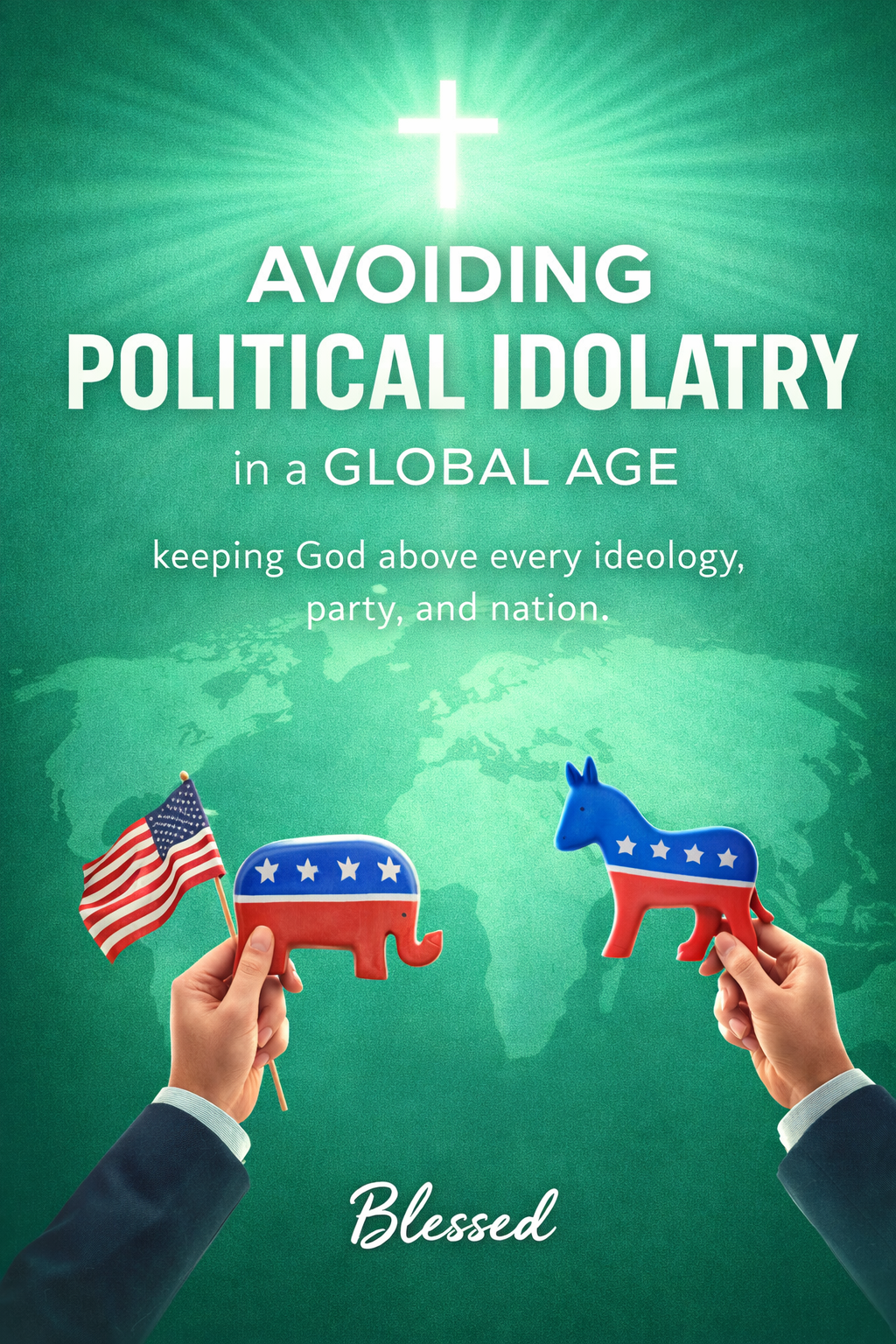
Avoiding Political Idolatry in a Global Age is not about withdrawing from politics—it is about keeping God above every ideology, party, and nation.
In today’s hyperconnected world, politics is no longer local. A speech in one nation trends globally within minutes. Policies made in one country affect economies, migration, climate, and security worldwide. Social media amplifies every debate, crisis, and election.
In such a climate, it is easy—even for believers—to allow political identity to overshadow spiritual identity.
But Scripture gives a clear reminder: “You shall have no other gods before Me” (Exodus 20:3). Political idolatry happens when loyalty to a party, leader, ideology, or nation begins to compete with loyalty to God.
Christians are called to engage society—but never to worship it.
Here’s how to stay politically engaged without falling into political idolatry.
1. Remember Your Primary Citizenship
Philippians 3:20 declares, “Our citizenship is in heaven.”
While Christians may deeply love their country, their ultimate allegiance is to God’s Kingdom.
Political idolatry begins when:
- A party becomes untouchable.
- A leader becomes unquestionable.
- National success becomes more important than moral obedience.
Actionable Steps:
- Regularly ask yourself: Would I still follow Christ if my political party changed direction?
- Evaluate policies through Scripture—not Scripture through politics.
- Pray for your nation without idolizing it.
Healthy patriotism honors a country. Idolatry worships it.
2. Refuse to Equate Christianity With a Political Party
No political party fully represents the Kingdom of God.
When believers merge faith with a party identity, they risk:
- Excusing immoral behavior for political gain.
- Ignoring injustice because it benefits their side.
- Dividing the body of Christ along political lines.
Jesus did not come to build a political party. He came to establish a Kingdom that transcends borders.
Example:
A Christian who supports a candidate should still hold that candidate accountable to biblical standards—whether they agree with them politically or not.
Actionable Steps:
- Avoid language that suggests one party “owns” Christianity.
- Be willing to critique policies from “your side.”
- Engage in conversations that prioritize truth over tribal loyalty.
3. Guard Your Heart Against Fear-Based Politics
Global politics often thrives on fear—fear of cultural loss, economic instability, immigration, war, or moral decline.
Fear-driven loyalty easily becomes idolatrous loyalty.
Scripture reminds us: “God has not given us a spirit of fear” (2 Timothy 1:7).
When fear drives political behavior:
- Compassion decreases.
- Hostility increases.
- Faith becomes reactive rather than rooted.
Actionable Steps:
- Limit constant exposure to outrage-driven media.
- Verify information before sharing.
- Respond with prayer before reacting with anger.
Faith must guide political engagement—not panic.
4. Value Truth Over Winning
In a polarized global age, “winning” often matters more than truth.
Political idolatry convinces people that:
- Lying is acceptable if it helps the cause.
- Smearing opponents is justified.
- Compromise of integrity is strategic.
But Proverbs 12:22 says, “The Lord detests lying lips, but He delights in people who are trustworthy.”
If Christians sacrifice truth to win political battles, they lose moral credibility—and damage their witness.
Actionable Steps:
- Refuse to spread unverified claims.
- Hold leaders accountable for dishonesty.
- Choose integrity over influence.
The Kingdom of God advances through righteousness, not manipulation.
5. Keep the Gospel Central
Political engagement is important—but it is not the Gospel.
No law can regenerate the human heart. No policy can replace salvation.
When Christians elevate politics above evangelism:
- The church risks becoming a political lobby.
- The message of salvation becomes secondary.
- Unity in Christ is replaced by ideological division.
Jesus said, “My kingdom is not of this world” (John 18:36).
Politics can shape society. Only Christ transforms souls.
Actionable Steps:
- Prioritize sharing the Gospel over winning arguments.
- Maintain fellowship with believers who differ politically.
- Keep church gatherings centered on Christ, not campaigns.
6. Practice Humility in Public Discourse
Political idolatry often produces pride. Humility dismantles it.
James 1:19 instructs believers to be “quick to listen, slow to speak, and slow to become angry.”
In a global age of instant commentary:
- Listening is rare.
- Patience is undervalued.
- Nuance is lost.
Christians must model a different approach.
Actionable Steps:
- Seek understanding before responding.
- Avoid dehumanizing language.
- Remember that political opponents are people made in God’s image.
Civility is not weakness—it is strength under control.
7. Distinguish Influence From Worship
Christians are called to influence society as salt and light (Matthew 5:13–16). Influence is biblical. Worshipping political systems is not.
Healthy engagement means:
- Voting thoughtfully.
- Advocating for justice.
- Supporting ethical leadership.
Idolatry means:
- Placing ultimate hope in elections.
- Believing a nation’s survival depends on one leader.
- Becoming spiritually shaken by political outcomes.
Our hope is not in governments—it is in God.
Signs You May Be Drifting Toward Political Idolatry
Ask yourself:
- Do I get more emotionally stirred by political news than by spiritual truth?
- Do I defend political leaders more passionately than I defend biblical values?
- Have I damaged relationships in the church over political differences?
- Do I justify wrongdoing because it benefits my preferred side?
Honest reflection protects spiritual health.
Final Reflection
Global politics is powerful. It shapes economies, freedoms, and futures. Christians should not withdraw from public life. But they must never elevate politics to the place reserved for God.
In a global age, believers must engage with courage—but anchor their identity in Christ alone.
Nations rise and fall. Political systems change. Leaders come and go.
But the Kingdom of God remains unshaken.
When Christians keep their allegiance clear, they can participate responsibly in global politics—without ever bowing to it.