
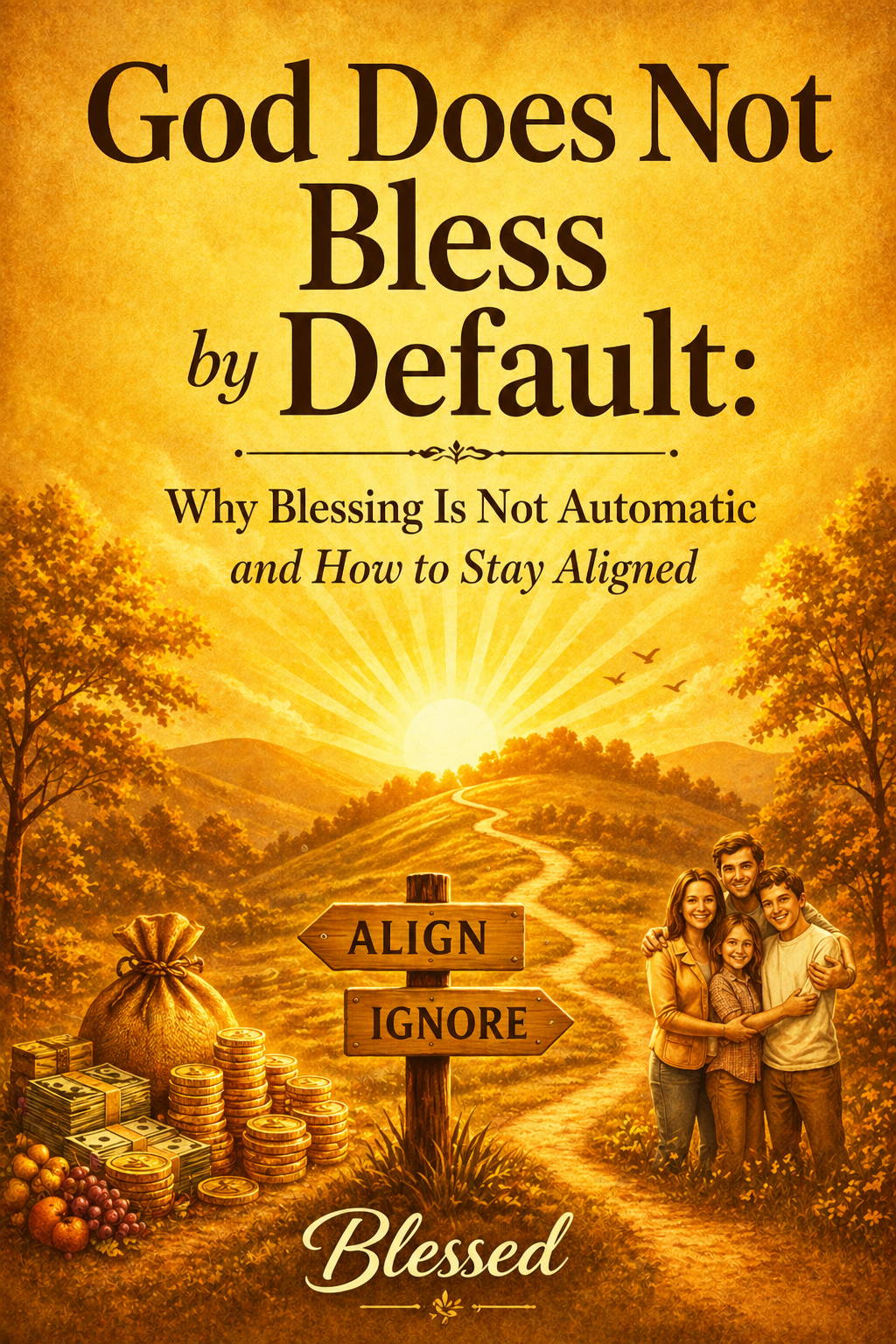
Introduction: The Truth Many Avoid
We all love the idea of a God who blesses.
We sing about it.
We pray for it.
We expect it.
It feels comforting to believe that blessings will simply come—without structure, responsibility, or alignment.
But beneath that belief lies a question many people quietly wrestle with:
If God blesses everyone, why do some lives move forward while others remain stuck?
Why do some people experience:
- Steady growth
- Inner peace
- Visible progress
…while others pray just as much but see little or no change?
It’s not an easy question. Many people avoid it.
But when you face it honestly, clarity begins to emerge.
Here is the truth:
Blessing is not automatic.
Not because God is unfair.
Not because He is unkind.
But because God works through principles—not emotions.
And once you understand this, your life shifts from passive expectation to intentional living.
Blessing Is Not Automatic — It Follows Alignment
We live in a fast-paced world:
- Instant messages
- Fast food
- Immediate gratification
So it’s easy to assume God works the same way.
But Scripture reveals a different pattern:
Blessing follows alignment.
Think about rain—it falls everywhere.
But:
- Prepared soil produces a harvest
- Hard ground produces nothing
The rain is the same. The difference is the condition of the ground.
In the same way:
- God’s love is unconditional
- But many of His blessings are experienced through alignment
Deuteronomy 28:1–2 (KJV):
“And it shall come to pass, if thou shalt hearken diligently unto the voice of the Lord thy God… that all these blessings shall come on thee, and overtake thee.”
That small word—“if”—is powerful.
It shows that blessing is not random.
It responds to alignment.
Emotion vs. Alignment: What Really Matters
Many people relate to God through emotion.
They:
- Pray intensely in difficult moments
- Make promises under pressure
- Feel spiritually strong for a short time
But emotion is unstable.
It rises and falls.
It reacts to circumstances.
Alignment is different.
Alignment is consistent, intentional, and practiced daily.
James 1:22 (KJV):
“But be ye doers of the word, and not hearers only…”
Emotion may begin your journey.
But only alignment sustains it.
A Real-Life Experience: When Alignment Is Missing
My Experience in Church
I once attended a church where the pastor was sincere and deeply committed to the things of God. He consistently prayed for the breakthrough of his members and encouraged everyone to seek God earnestly.
The central message in the church was simple: pray for a breakthrough.
Many people took this seriously. They prayed regularly and expected change. However, only a small number of members experienced visible progress.
Over time, it became clear that those who saw results were not just praying—they were also applying biblical principles in their daily lives.
As a result, others became discouraged. When their efforts didn’t produce the same outcomes, some began to question the church itself. A few even assumed something was wrong with the pastor and eventually left.
Looking back, the issue was not the prayers—it was the absence of alignment.
Blessing is not based on effort alone. It is rooted in alignment with God’s principles.
Why Some Receive While Others Don’t
This is often misunderstood.
Some assume:
- God is favoring certain people
- God is ignoring others
However, in most cases, the difference is not due to favoritism.
It is positioning.
Two people can:
- Pray the same prayers
- Desire the same results
- Believe in the same breakthrough
Yet experience completely different outcomes.
Why?
Because one aligns their life with God’s principles—
while the other relies mainly on hope and emotion.
Galatians 6:7 (KJV):
“Whatsoever a man soweth, that shall he also reap.”
This is not punishment.
It is a principle.
Core Principles That Position You for Blessing
1. Obedience: The Foundation
Obedience is not control—it is trust.
Isaiah 1:19 (KJV):
“If ye be willing and obedient, ye shall eat the good of the land.”
2. Alignment: Direction Over Perfection
You don’t need perfection—you need direction.
Amos 3:3 (KJV):
“Can two walk together, except they be agreed?”
3. Faithfulness: The Power of Consistency
Big results often come from small, consistent actions.
Luke 16:10 (KJV):
“He that is faithful in that which is least…”
4. Stewardship: Managing What You Have
God does not increase what is poorly managed.
1 Corinthians 4:2 (KJV):
“It is required in stewards that a man be found faithful.”
5. Integrity: The Hidden Strength
Integrity is who you are when no one is watching.
Proverbs 11:3 (KJV):
“The integrity of the upright shall guide them.”
6. Sacrifice: The Cost of Growth
Growth requires letting go of comfort.
2 Samuel 24:24 (KJV):
“…nor offer… that which doth cost me nothing.”
The Deeper Question: What Happens When Blessing Comes?
Most people focus on receiving.
Few prepare for managing.
But this is critical:
Blessing without alignment can become a distraction.
What you prayed for can pull you away—
If your foundation is not strong.
Money and Blessing: A Test of Alignment
Money is one of the clearest tests of alignment.
It can:
- Create impact
- Support others
- Open opportunities
But it can also:
- Shift your focus
- Create pride
- Replace dependence on God
The issue is not money.
The issue is the condition of your heart.
How to Stay Aligned While Using What God Gives You
- See yourself as a steward, not an owner
- Guard your heart against unhealthy attachment
- Stay focused on your purpose
- Practice intentional giving
- Remain disciplined in your decisions
- Stay humble as you grow
- Keep your relationship with God central
The Hard but Liberating Truth
This message is not meant to discourage you.
It is meant to empower you.
Blessing is not random.
That means:
- You are not forgotten
- You are not unlucky
- You are not excluded
You simply need alignment.
Conclusion: Blessing Is Intentional
God’s love is free.
His grace is available.
But sustained blessing is intentional.
It flows where there is:
- Obedience
- Alignment
- Faithfulness
- Stewardship
- Integrity
- Sacrifice
Not perfection—
but posture.
Final Reflection
Ask yourself honestly:
- Am I aligned with what I am asking God for?
- Am I managing what I already have well?
- Am I consistent in my actions?
Final Prayer
“Lord, help me align my life with Your will.
Teach me wisdom, discipline, and humility.
Guide my decisions and help me use every resource for good.
Let my life reflect Your principles. Amen.”
Closing Thought
Blessing is not just about receiving.
It is about being ready.
And when your life aligns with God’s ways—
You don’t just ask for blessings…
You become positioned for them.