
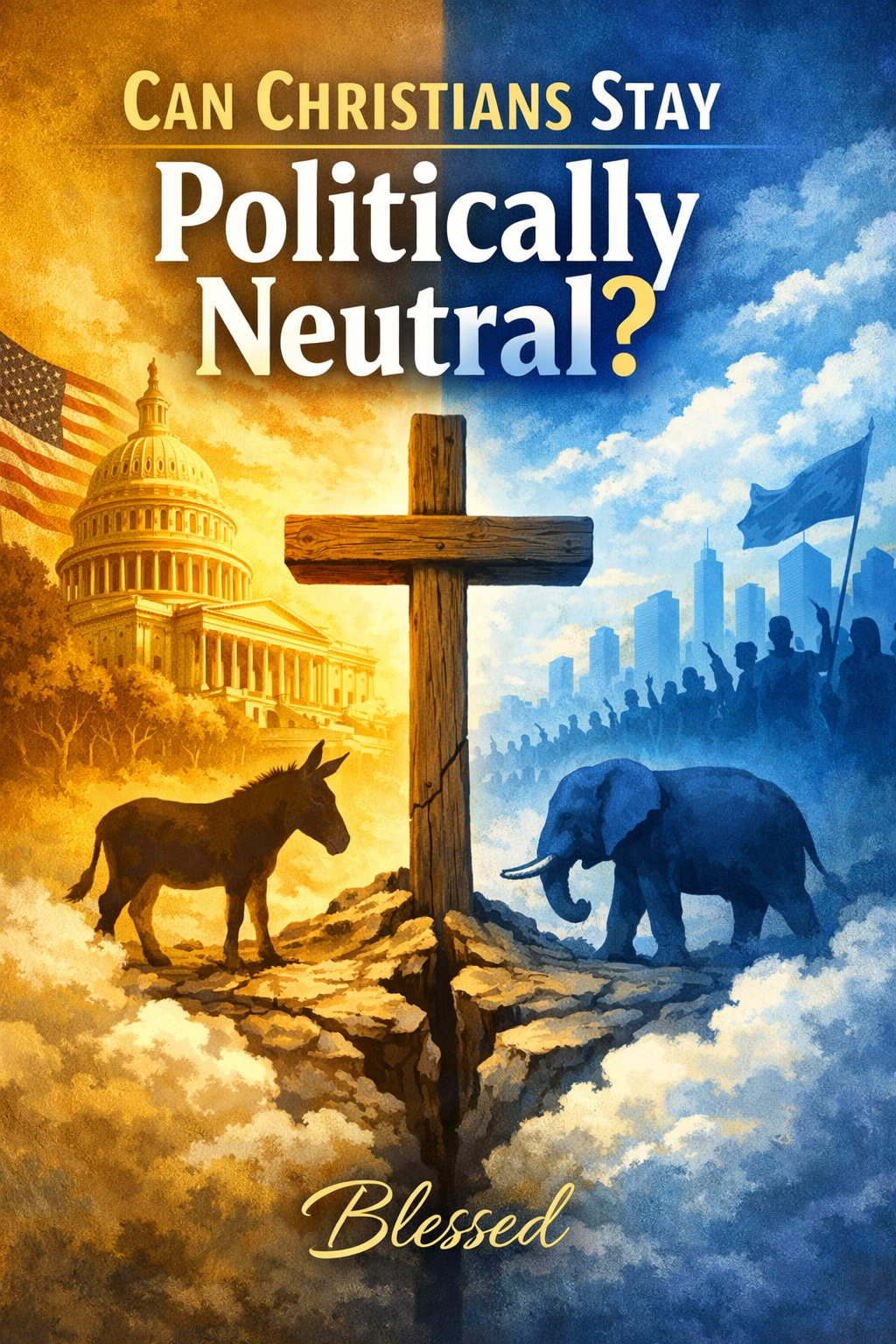
Can Christians Stay Politically Neutral?
In an age of elections, culture wars, social media outrage, and ideological battles, one question keeps surfacing in churches across America and Europe:
Can Christians remain politically neutral?
For many believers, politics feels exhausting. For others, it feels unavoidable. Some argue that faith demands political engagement. Others insist that Christianity transcends party lines altogether.
So where does the truth lie?
The Tension Between Faith and Politics
Christianity has always existed within political systems. From the Roman Empire to modern democracies, believers have had to navigate loyalty to God while living under earthly governments.
The core tension is this:
- Christianity is rooted in eternal truth.
- Politics is rooted in temporary power.
When Christians become too politically attached, faith can begin to look like a campaign strategy rather than a spiritual conviction. Yet when Christians disengage completely, they may withdraw from influencing justice, compassion, and moral integrity in society.
Neutrality, then, is not as simple as silence.
What Does “Political Neutrality” Really Mean?
There are three common interpretations:
- Party Neutrality – Not aligning fully with any political party.
- Policy Neutrality – Avoiding strong stances on controversial issues.
- Civic Withdrawal – Avoiding politics altogether.
These are not the same.
A Christian may reject partisan loyalty while still advocating for justice, human dignity, religious freedom, and care for the vulnerable. That is not political apathy; it is moral conviction without partisan captivity.
The Risk of Political Idolatry
One of the greatest dangers for Christians in Western democracies is political idolatry.
This happens when:
- A party becomes more trusted than biblical principles.
- A candidate becomes defensive at all costs.
- Political identity overrides spiritual identity.
When faith becomes fused with a political tribe, the gospel can be reduced to a campaign slogan.
In both the United States and Europe, churches have faced criticism for appearing aligned with specific political movements. This alignment often damages credibility among younger generations who are skeptical of institutional power.
Neutrality, in this sense, can be a safeguard against idolizing political power.
But Is Total Neutrality Biblical?
Complete disengagement presents another problem.
Christian teachings emphasize:
- Justice
- Compassion
- Protection of the vulnerable
- Accountability of leaders
These values inevitably intersect with public policy.
For example:
- Immigration debates touch on human dignity.
- Economic policy affects poverty.
- Free speech laws affect religious liberty.
- War and peace decisions affect human life.
Christians cannot pretend these issues are purely “political” and not moral.
The real question is not whether Christians should engage — but how.
A Third Way: Principled Engagement Without Partisan Captivity
Instead of choosing between activism and apathy, Christians can adopt a third approach:
1. Anchor Identity in Faith, Not Party
Political affiliation should never define spiritual identity. A Christian’s allegiance is first to God, not to a platform.
2. Evaluate Policies, Not Personalities
Rather than defending a candidate unconditionally, believers can assess policies based on moral consistency, long-term consequences, and human dignity.
3. Practice Civil Discourse
In polarized societies, respectful disagreement is radical. Christians can model thoughtful conversation rather than online hostility.
4. Separate Eternal Truth from Political Strategy
No party fully represents Christian ethics. Every ideology has blind spots. Recognizing this prevents blind loyalty.
5. Prioritize Character Over Outrage
Political systems reward outrage. Christian faith rewards humility, patience, and self-control.
These virtues matter more than winning arguments.
Why This Matters in the US and Europe
Western democracies are increasingly divided. Polarization has reached levels where friendships, churches, and even families are strained by political differences.
If Christians mirror the same hostility seen in broader society, they lose moral distinction.
But if they engage thoughtfully, refusing both apathy and fanaticism, they offer something different — stability in chaos.
So, Can Christians Stay Politically Neutral?
If neutrality means:
- Avoiding political idolatry — Yes.
- Refusing blind party loyalty — Yes.
- Withdrawing from civic responsibility — No.
- Ignoring injustice — No.
Christian neutrality is not silence. It is independence.
It is the ability to critique any party, affirm truth wherever it appears, and reject policies that conflict with moral conviction — regardless of which side proposes them.
That kind of engagement is not a weakness. It is maturity.
Final Thought
In a global age of ideological extremes, the Christian challenge is not choosing red or blue, left or right.
It is choosing integrity over tribalism.
And sometimes, the most powerful political statement a believer can make is this:
“My faith shapes my politics — my politics do not shape my faith.”