
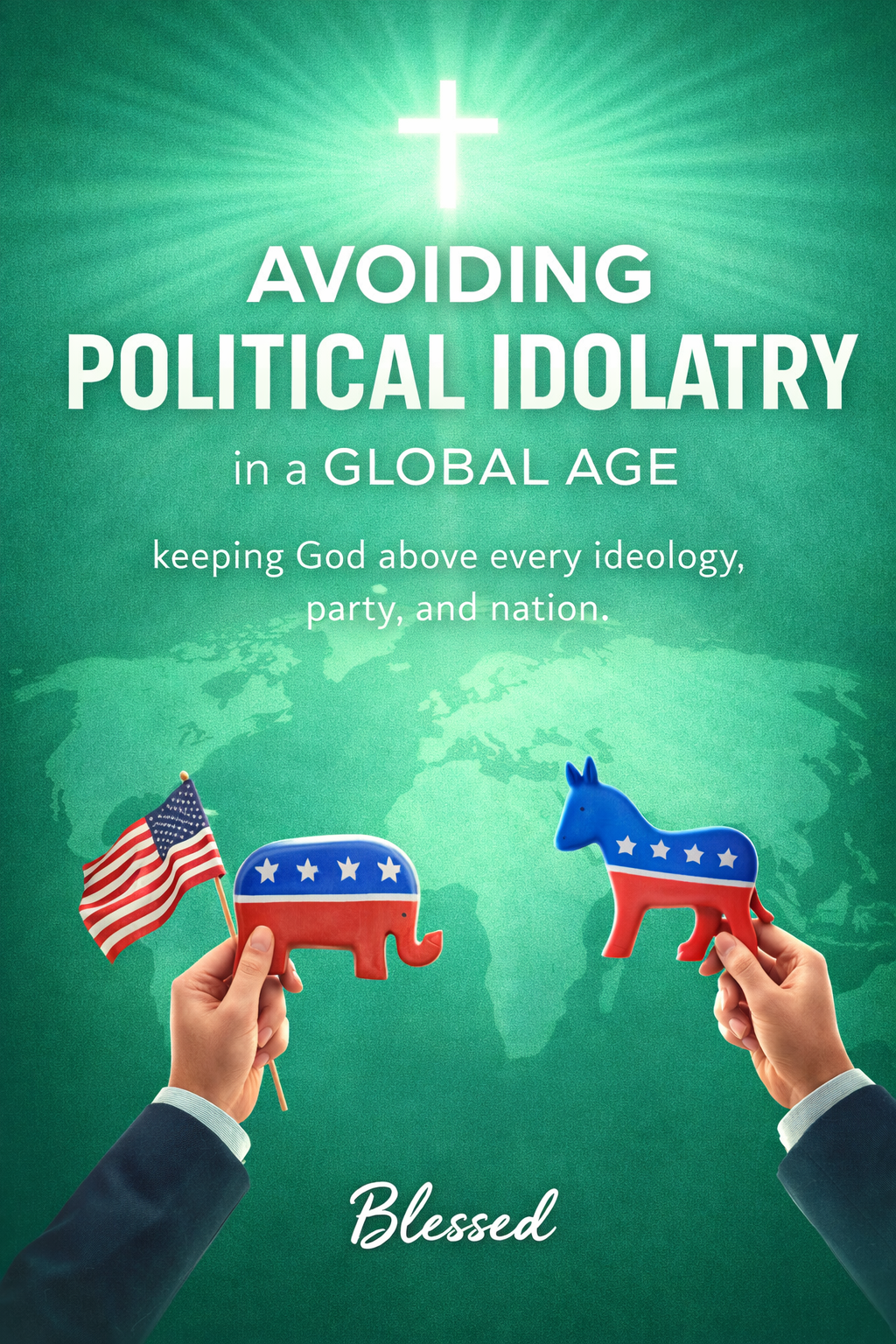
Avoiding Political Idolatry in a Global Age: Keeping God Above Every Nation, Party, and Ideology
In today’s fast-moving global world, politics is no longer something that stays within borders. A single speech can trend worldwide in minutes. Elections in one country can influence economies, migration, security, and even cultural debates across continents.
For Christians, this creates a serious spiritual challenge: how do you stay engaged in politics without allowing it to take the place of God in your heart?
The answer is simple, but not always easy—you can participate in politics without worshipping it.
This is where the danger of political idolatry begins.
What Is Political Idolatry?
Political idolatry happens when loyalty to a party, leader, ideology, or nation becomes more important than loyalty to God.
It is not about being politically aware or active. Christians are encouraged to care about justice, leadership, and governance.
But idolatry begins when:
- A political party becomes unquestionable
- A leader becomes almost “infallible.”
- National identity overrides spiritual identity
- Scripture is reshaped to fit political views
“You shall have no other gods before Me.” — Exodus 20:3
When politics begins to shape your faith instead of your faith shaping your politics, something has gone out of order.
1. Remember Your True Citizenship
One of the strongest biblical reminders comes from:
“Our citizenship is in heaven.” — Philippians 3:20
This does not mean Christians should ignore their country. It means your highest identity is not national—it is spiritual.
Practical Balance:
- Love your country, but don’t worship it
- Pray for your nation without idolizing it
- Judge policies through Scripture, not emotions
- Stay loyal to Christ above political systems
Healthy patriotism is good. But when a nation becomes your ultimate hope, it quietly becomes an idol.
2. Do Not Turn Any Political Party Into a “Christian Party.”
No political party fully represents the Kingdom of God.
When Christians fully merge faith with party identity, it leads to:
- Excusing sin for political advantage
- Ignoring injustice on “your side.”
- Dividing the church along political lines
Jesus never came to form a political movement. He came to establish a Kingdom that transcends all systems.
Practical Balance:
- Do not assume one party owns biblical truth
- Be willing to correct “your side.”
- Prioritize truth over loyalty
3. Guard Against Fear-Driven Politics
Much of global politics today runs on fear:
- Fear of economic collapse
- Fear of cultural change
- Fear of insecurity or war
- Fear of losing influence
But fear is a powerful spiritual trap.
“God has not given us a spirit of fear.” — 2 Timothy 1:7
Fear makes people react instead of think. It pushes believers into extreme positions and weakens spiritual discernment.
Practical Balance:
- Limit the constant political outrage content
- Verify information before reacting
- Pray before sharing or commenting
- Let peace—not panic—guide your response
4. Choose Truth Over Political Loyalty
In highly polarized environments, “winning” often becomes more important than truth.
But Scripture is clear:
“The Lord detests lying lips.” — Proverbs 12:22
When believers justify dishonesty for political gain, they weaken their spiritual witness.
Practical Balance:
- Do not share unverified political claims
- Reject manipulation and propaganda
- Refuse to defend what God calls wrong
- Let integrity lead your engagement
5. Keep the Gospel at the Center
Politics can influence society, but it cannot transform the human heart.
Only the Gospel can do that.
“My kingdom is not of this world.” — John 18:36
When politics becomes central in a believer’s life, the Gospel slowly becomes secondary.
Practical Balance:
- Prioritize evangelism over argument
- Keep church unity above political agreement
- Remember: salvation is not political—it is spiritual
6. Practice Humility in Political Conversations
Political discussions often bring out pride, anger, and division.
But Scripture calls believers to a different standard:
“Be quick to listen, slow to speak, slow to become angry.” — James 1:19
Practical Balance:
- Listen more than you speak
- Avoid insulting or dehumanizing others
- Remember, every person is made in God’s image
- Value peace over “winning debates.”
7. Influence Politics Without Worshipping It
Christians are called to be salt and light:
“You are the light of the world.” — Matthew 5:14
That means engagement—not withdrawal.
But influence is not the same as worship.
Healthy Influence Looks Like:
- Voting responsibly
- Speaking against injustice
- Supporting ethical leadership
Political Idolatry Looks Like:
- Putting ultimate hope in elections
- Believing one leader will “save everything.”
- Losing faith when political outcomes change
Signs You May Be Drifting Into Political Idolatry
Ask yourself honestly:
- Do political issues affect me more than spiritual truths?
- Do I defend political leaders more than biblical values?
- Have I damaged relationships over politics?
- Do I excuse wrongdoing because of “my side”?
These are not accusations—they are reflections for spiritual health.
Final Reflection
Politics is powerful. It shapes nations, economies, and cultures. But it must never shape your worship.
Christians are called to engage the world, not escape it—but also not idolize it.
Governments change. Leaders rise and fall. Nations shift.
But God remains eternal, unchanging, and sovereign.
Your ultimate loyalty must always remain clear:
God first. Everything else second.
Frequently Asked Questions (FAQs)
1. What is political idolatry in Christianity?
Political idolatry is when a person gives ultimate loyalty, trust, or emotional dependence to a political party, leader, or nation instead of God.
2. Can Christians be involved in politics?
Yes. Christians are encouraged to engage in society, vote responsibly, and speak for justice—but without replacing God with political systems.
3. How do I stay balanced in politics as a Christian?
Stay balanced by prioritizing Scripture over ideology, avoiding fear-driven reactions, and keeping your identity rooted in Christ rather than political affiliation.
4. Is patriotism a sin?
No. Patriotism is not a sin. However, it becomes dangerous when love for country replaces love for God or overrides biblical truth.
5. Why is political idolatry dangerous?
It shifts a believer’s trust from God to human systems, increases division, and weakens spiritual discernment and unity in the church.