
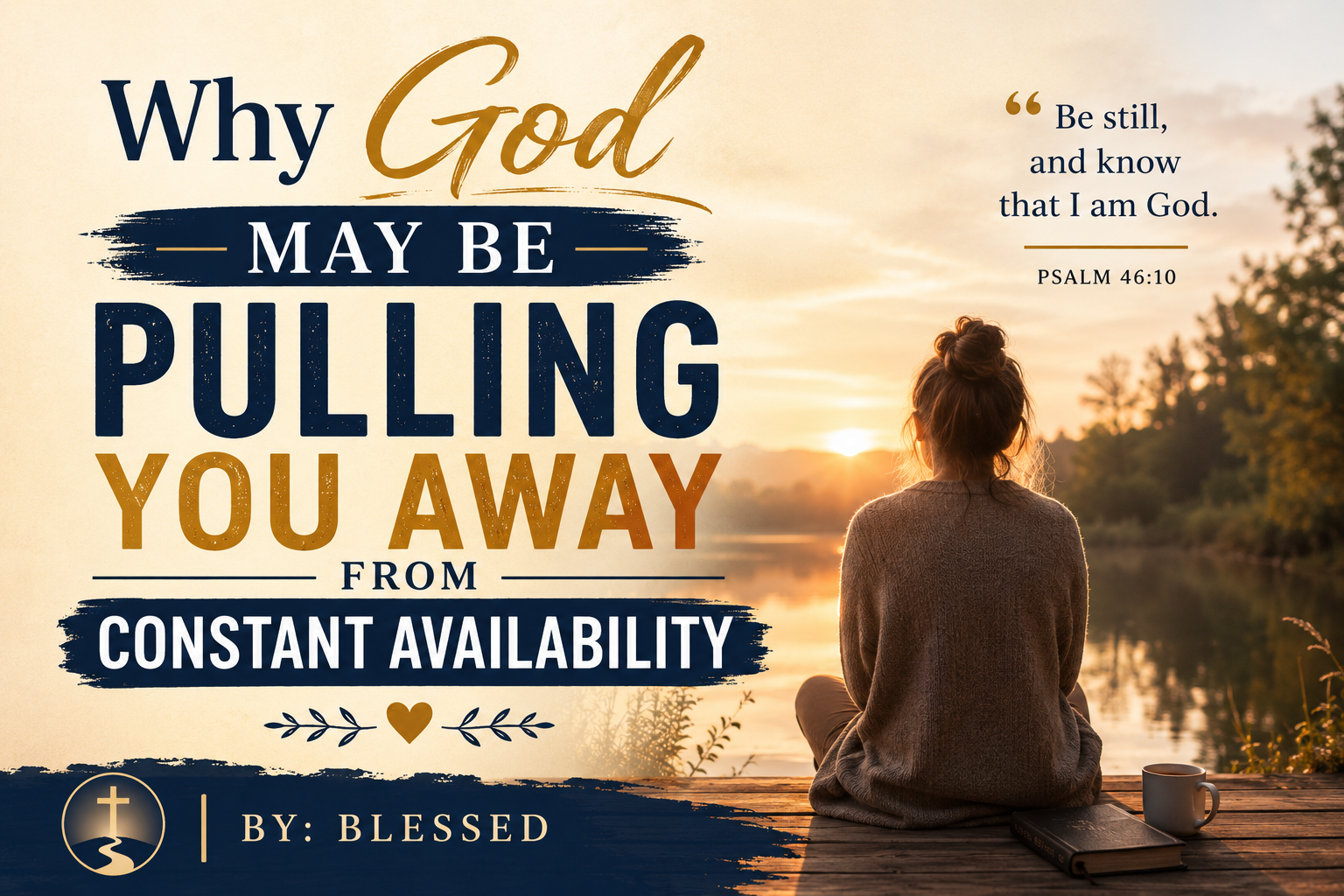
Your Notifications Never Sleep — But Your Soul Is Tired
Late at night, another message appears on your screen, and once again, you respond.
Not because you truly have the strength.
Not because you genuinely have the time.
But because you feel guilty ignoring it.
You keep showing up for everyone.
You answer calls while eating.
You accept responsibilities you barely have room for.
You stay emotionally available long after your mind and body have become exhausted.
And slowly, without even noticing it, your inner life with God begins to weaken.
You still attend church.
You still pray occasionally.
You still serve.
But deep inside, something feels drained.
Many believers never realize this can happen. They assume constant activity automatically means spiritual maturity. But a crowded schedule is not always evidence of obedience.
Sometimes it is evidence of an imbalance.
There are seasons when God intentionally calls His people away from endless noise, endless requests, and endless accessibility — not to punish them, but to restore them.
“Be still, and know that I am God.” — Psalm 46:10
Sometimes the holiest thing you can do is step back long enough to hear His voice again.
The Dangerous Idea Many Christians Believe
A quiet mindset has spread through modern Christian culture:
- If you love people, you must always be reachable.
- If you care, you must always say yes.
- If you are unavailable, you are failing others.
At first, this sounds loving and spiritual.
But over time, this mentality creates exhausted believers who are constantly giving while rarely being renewed.
Many people are not driven by peace when they overcommit themselves.
They are driven by fear.
Fear of disappointing others.
Fear of being misunderstood.
Fear of looking selfish.
Fear of not being needed anymore.
As a result, they stay busy every moment of the day, convincing themselves they are serving God while quietly neglecting their own spiritual health.
But living without limits does not make someone spiritually stronger.
In many cases, it slowly empties them.
“For God is not the author of confusion, but of peace.” — 1 Corinthians 14:33
Jesus Never Lived Under Constant Human Demands
When you study the life of Jesus, one thing becomes very clear:
He did not respond to every demand immediately.
Crowds followed Him everywhere.
People constantly needed healing.
Others wanted answers, miracles, or attention.
Yet Jesus repeatedly withdrew from the noise.
He stepped away from the crowds.
He spent time alone in prayer.
He separated Himself from constant public pressure.
“But Jesus often withdrew to lonely places and prayed.” — Luke 5:16
Even when people searched for Him, He did not allow urgency to control Him.
Jesus understood that intimacy with the Father mattered more than satisfying every expectation around Him.
That truth is important.
Because many believers today are trying to carry responsibilities God never asked them to carry.
“Very early in the morning, while it was still dark, Jesus got up, left the house and went off to a solitary place, where he prayed.” — Mark 1:35
What Constant Availability Slowly Destroys
Being endlessly reachable may look productive on the outside, but internally, it can create serious spiritual damage.
1. Your spiritual sensitivity weakens.
When your life becomes nonstop noise, it becomes harder to recognize God’s direction clearly.
Your mind stays crowded.
Your thoughts stay rushed.
Your heart rarely becomes still enough to listen.
“In quietness and trust shall be your strength.” — Isaiah 30:15
2. Service becomes draining instead of joyful.
At first, helping people feels meaningful.
But eventually, exhaustion replaces compassion.
You begin serving from pressure instead of love.
“Let us not become weary in doing good.” — Galatians 6:9
3. Your prayer life becomes shallow.
Instead of resting in God’s presence, prayer becomes a hurried conversation squeezed between responsibilities.
There is little quietness.
Little reflection.
Little renewal.
“Come near to God, and He will come near to you.” — James 4:8
4. Frustration quietly grows.
Burnout rarely announces itself loudly at first.
It grows slowly.
One day, you realize that simple requests irritate you, conversations feel heavy, and ministry feels more like survival than purpose.
That is often what happens when people continuously pour out without allowing God to refill them.
“My soul finds rest in God alone.” — Psalm 62:1
Stepping Back Requires Trust
Many people think rest is a weakness.
Spiritually, it is often the opposite.
Choosing to pause requires trust in God.
It means believing that God can continue working even when you are not constantly involved.
It means accepting that you are not responsible for controlling everything around you.
That can be uncomfortable.
Some people stay overly available because they secretly believe everything depends on them.
But God never asked anyone to carry that burden.
“Cast all your anxiety on Him because He cares for you.” — 1 Peter 5:7
Rest reminds you that God remains faithful even when you slow down.
Silence reminds you that His power does not depend on your nonstop activity.
And healthy limits remind you that you are human — not infinite.
“Unless the Lord builds the house, the builders labor in vain.” — Psalm 127:1
Even Jesus Practiced Boundaries
Jesus loved people deeply, yet He still maintained boundaries.
He did not travel everywhere people wanted Him to go.
He did not answer every accusation.
He did not spend every moment surrounded by crowds.
He understood the importance of withdrawing before exhaustion consumed Him.
This matters because many believers feel guilty whenever they create limits.
But healthy boundaries are not selfish when they protect your spiritual health, emotional stability, and relationship with God.
A life without boundaries eventually becomes unsustainable.
You cannot continue pouring into others while completely neglecting your own soul.
“Above all else, guard your heart, for everything you do flows from it.” — Proverbs 4:23
Why Rest Often Feels Uncomfortable
One reason many people struggle with slowing down is that stillness exposes what busyness hides.
When life becomes quiet, thoughts surface.
Emotions surface.
Spiritual emptiness becomes harder to ignore.
That is why many people keep themselves constantly distracted.
But God often works most deeply in quiet places.
Not every important moment happens in noise, crowds, or activity.
Some of the greatest spiritual renewals happen in silence, reflection, and rest.
Stillness gives God room to heal what constant motion keeps covering up.
“He leads me beside quiet waters, He refreshes my soul.” — Psalm 23:2–3
Practical Ways to Become Spiritually Healthy Again
Protect the beginning of your day.
Do not allow notifications to become the first voice shaping your mind every morning.
Spend intentional time with God before entering the demands of the day.
“Seek first His kingdom and His righteousness.” — Matthew 6:33
Reduce unnecessary digital pressure.
Not every message requires an immediate answer.
Creating small spaces of silence can dramatically improve your emotional and spiritual health.
Learn to say no wisely.
Some responsibilities are assignments from God.
Others are distractions fueled by guilt or pressure.
Discern the difference.
“Let your ‘Yes’ be yes, and your ‘No,’ no.” — Matthew 5:37
Make room for genuine rest.
Rest is not laziness.
God designed human beings with limits for a reason.
Ignoring those limits eventually produces exhaustion.
“Come to Me, all you who are weary and burdened, and I will give you rest.” — Matthew 11:28
Reevaluate your commitments regularly.
Ask yourself honestly:
- Is this helping my relationship with God?
- Am I serving from peace or from pressure?
- Am I constantly busy but spiritually empty?
Those questions matter.
God Does Not Want a Burned-Out Version of You
Many people spend years trying to be everything for everyone.
But eventually, exhaustion catches up.
God never intended for your entire life to revolve around constant pressure, nonstop availability, and emotional depletion.
He desires obedience more than endless activity.
He desires intimacy more than performance.
“Martha, Martha,” the Lord answered, “you are worried and upset about many things, but few things are needed — or indeed only one.” — Luke 10:41–42
Sometimes stepping away from noise is not a weakness.
Sometimes it is wisdom.
And sometimes the most spiritually mature decision you can make is to disconnect from unnecessary demands long enough to reconnect with God Himself.
Because the world does not simply need more of your activity.
It needs the version of you that has spent time in the presence of God.