
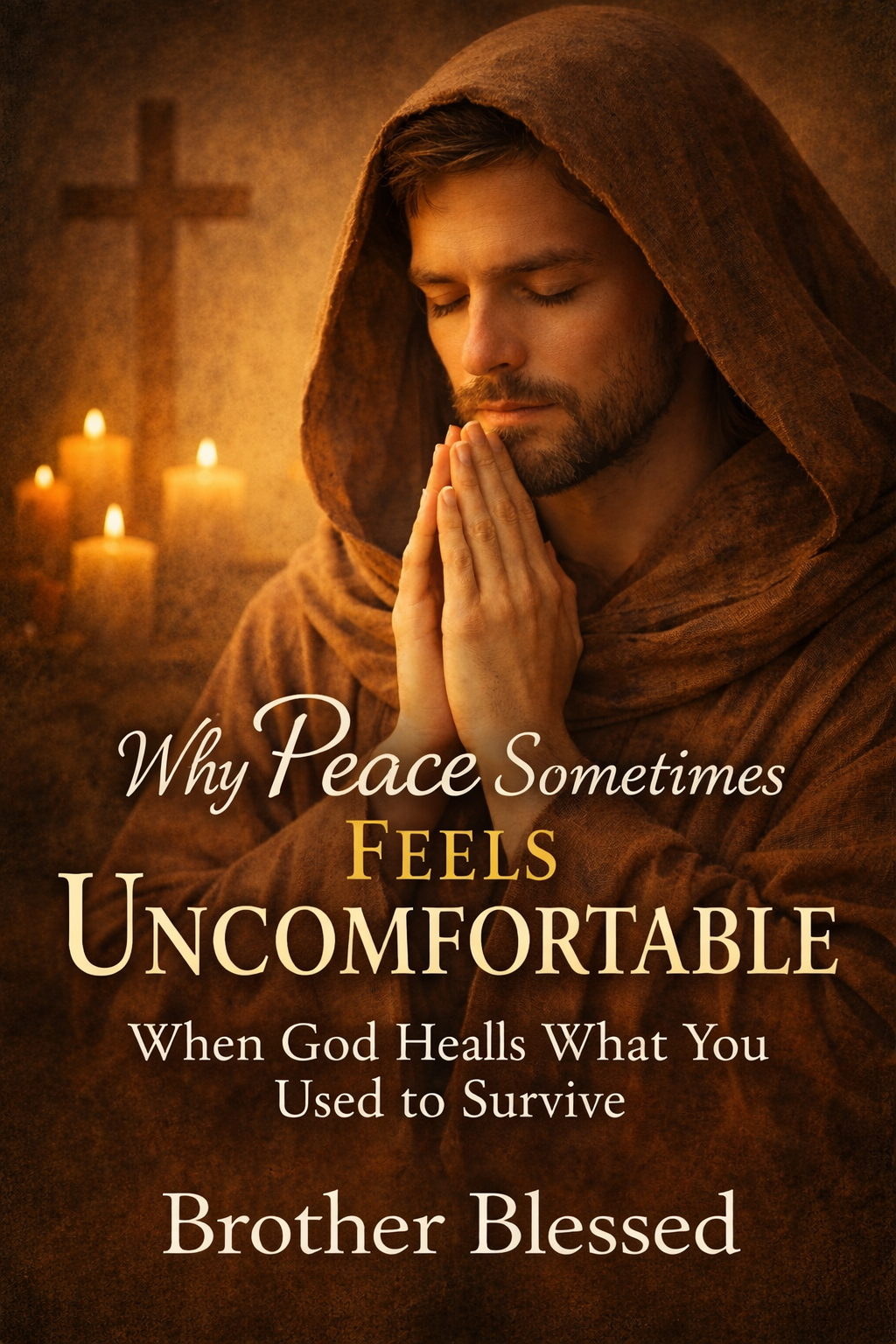
What nobody tells you about the strange anxiety that comes when life finally gets quiet
You prayed for this.
You prayed for the chaos to stop. For the noise to fade. For the relationship drama, the financial panic, the constant emotional emergencies to finally — finally — settle down.
And then one day, they did.
The house got quiet. The crisis passed. The storm moved on. And instead of exhaling into relief, you felt something you didn’t expect: a low, creeping unease. An itch you couldn’t locate. A strange sense that something must be wrong because nothing was wrong.
If that experience sounds familiar, you’re not broken. You’re not ungrateful. And you’re certainly not alone.
What you’re experiencing has a name — and understanding it might be the most important thing you do for your healing this year.
Your Nervous System Learned to Live in the Storm
Before we talk about peace, we need to talk about what came before it.
Many people — more than would ever admit it — didn’t grow up in environments where calm was the baseline. They grew up in homes where emotional temperature could shift without warning. Where love felt conditional. Where disappointment was common enough that expecting it felt smarter than hoping against it.
So they adapted.
They became hypervigilant — always scanning for the next problem, always reading rooms, always prepared for disruption. They learned to function at a high level under pressure because pressure was the only constant they could rely on. Crisis didn’t paralyze them. In fact, crisis was where they felt most alive, most capable, most needed.
Survival became a skill. And then survival became an identity.
The trouble is, the nervous system doesn’t know the difference between a threat that’s real and a threat that’s simply familiar. When calm arrives, the body doesn’t automatically relax into it. It goes looking for the fire that isn’t there anymore — because fire is what it knows.
This is not a character flaw. It’s a conditioned response. And it’s exactly what God begins to work on when He decides it’s time to heal you.
The Biblical Example: Israel in the Wilderness
There’s a story in the Old Testament that maps this experience with remarkable precision.
After four hundred years of slavery in Egypt, God delivered the Israelites. Dramatically. Miraculously. With signs and wonders that should have settled the question of His faithfulness once and for all. The Red Sea split. Pharaoh’s army drowned. They walked out free.
And then — almost immediately — they panicked.
Not because something went wrong. But because the familiar structure of suffering was gone. Slavery, for all its cruelty, had given them a predictable rhythm. They knew where their food came from. They knew what each day would look like. Even their oppression had a routine.
Freedom didn’t feel like relief. It felt disorienting. Threatening. Empty.
“If only we had died by the Lord’s hand in Egypt! There we sat around pots of meat and ate all the food we wanted, but you have brought us out into this desert to starve this entire assembly to death.” — Exodus 16:3
Read that slowly. These were people who had been whipped, enslaved, and systematically dehumanized — and they were nostalgic for it. Not because Egypt was good, but because Egypt was known. The wilderness of freedom felt more frightening than the structure of bondage.
This is not ancient history. This is a pattern that plays out in human psychology every single day — in people who stay in toxic relationships because the pain is predictable, in people who manufacture drama when life gets too quiet, in people who feel guilty about feeling okay.
You are not the first person whose soul struggled to receive what it had been praying for.
What Healing Actually Feels Like From the Inside
Here’s what the healing process rarely looks like: a gentle, cinematic moment of release where peace washes over you like warm water, and everything finally makes sense.
Here’s what it more commonly looks like: confusion. Grief. Disorientation. The unsettling sensation of not knowing who you are when you’re not in survival mode.
When God begins to heal the deep places — the places that learned to operate on fear, on hypervigilance, on emotional armor — the process involves dismantling the very systems you built to protect yourself. And dismantling feels like loss before it feels like freedom.
Peace exposes things that busyness and chaos were covering. When the noise stops, the unprocessed grief rises. The unresolved anger surfaces. The questions you never had time to ask suddenly have nowhere to hide.
This is not God abandoning you to your pain. This is God saying: You’re safe enough now to feel this. I’m not going anywhere. Let it come up.
The quiet is not emptiness. It’s an invitation.
When Peace Challenges the Identity You Built to Survive
There’s something else that makes peace uncomfortable — and it’s more subtle than anxiety.
For people who have survived hard things, strength becomes a core part of their self-concept. I am the one who handles it. I am the one who doesn’t fall apart. I am the one people call in a crisis.
That identity is not without its beauty. Resilience is genuinely admirable. The ability to hold steady when everything is shaking is a remarkable human capacity.
But there’s a shadow side: when strength becomes the only mode you know, rest starts to feel like weakness. Receiving care feels uncomfortable. Vulnerability feels dangerous. Needing people feels like a liability.
Peace asks you to release the very thing you most identified with.
It says: You don’t have to manage everything anymore. You don’t have to be the strong one right now. You are allowed to be held.
For someone who spent years surviving by never letting their guard down, that invitation can feel more threatening than the chaos ever did.
How to Lean Into the Peace That Feels Wrong
This is the actionable part — but understand that these aren’t quick fixes. They’re practices. Approaches. Things to return to repeatedly as your soul slowly learns a new way of being.
1. Name what’s happening without judging it. The moment you notice the discomfort — the restlessness, the manufactured worry, the urge to create a problem to solve — name it out loud or in writing: “I feel unsettled in this peace because peace is unfamiliar to me.” That single act of naming interrupts the automatic cycle and creates space between you and the reaction.
2. Resist the urge to fill the quiet. Every time life gets peaceful, there’s a pull toward busyness — another project, another conversation, another distraction. Notice that pull. You don’t have to obey it. Sit in the quiet for five minutes longer than feels comfortable. That discomfort is not danger. It’s your nervous system recalibrating.
3. Let what surfaces, surface. When the grief comes up in the calm — and it will — don’t run from it. The emotions that arise in peaceful seasons are not new wounds. They’re old ones that finally have enough safety to be felt. Let them come. Journal them. Pray through them. Bring them to a trusted person or counselor.
4. Practice receiving, not just giving. People who have survived by being strong often become compulsive givers — because giving feels safer than needing. This season, practice letting someone care for you. Accept the meal. Receive the prayer. Let someone sit with you in your quiet rather than performing strength you don’t currently feel.
5. Redefine what safety actually means. For much of your life, safety may have meant being prepared for anything. Staying ready. Never being caught off guard. But that is not safety — that is exhaustion masquerading as control. Real safety is not the absence of uncertainty. It is the settled conviction that you are not alone in it. Practice saying, and meaning: “I don’t have to manage this by myself.”
What God Is Actually Doing in the Quiet
When God heals what you used to survive, He is not taking away your strength. He is teaching you that you were never the source of it.
The armor you built — the emotional distance, the hypervigilance, the compulsive self-sufficiency — was never who you truly were. It was what you became in response to an environment that required it. And it served you. It genuinely kept you standing when you might otherwise have fallen.
But God is interested in more than keeping you standing. He is interested in you flourishing.
There’s a beautiful image in Psalm 23 that captures this. The psalmist doesn’t describe a God who prepares you for battle. He describes a God who makes you lie down in green pastures. Who leads you beside still waters. Who restores your soul.
Restoration is not a violent process. It is a tender one. But it does require you to stop moving long enough to be restored.
The still water David writes about isn’t boring. It isn’t weakness. It is what becomes possible after the survival chapter ends.
For the One Who Doesn’t Know How to Rest
If you’ve read this far and something in you is quietly undone — if this has touched a place that doesn’t have language yet — let this land gently:
The fact that peace feels strange doesn’t mean you don’t deserve it.
It means you’ve been in survival mode for so long that your soul has forgotten what it was made for. And what you were made for was never just endurance.
You were made for wholeness. For rest. For the kind of deep, unearned, unconditional okayness that doesn’t depend on circumstances staying manageable.
That kind of peace is not something you build. It’s something you receive.
And the first step toward receiving it is simply acknowledging that you’ve been afraid of it — and choosing, slowly, imperfectly, one quiet moment at a time, to let it in.
Has peace ever felt uncomfortable or foreign to you? Share your experience in the comments — someone reading this today may find exactly the courage they need in your words.